

Is the UK’s Modern Industrial Strategy really Place-Based?
By David Bailey, Lisa De Propris, Chris Dimos, Felicia Fai, Sally Hardy, and Philip R Tomlinson
The UK’s Modern Industrial Strategy has been presented as a bold plan for economic renewal: a promise to boost productivity, spread opportunity across regions, support innovation, and rebalance an economy long dominated by London and the South East.
In a new critical review published in the Policy Debates section of Regional Studies, we argue that the Modern Industrial Strategy, for all its ambition, fundamentally misses the mark.
At the heart of our critique is a simple but uncomfortable message: the UK continues to talk about place-based policy without truly practising it. While policymakers acknowledge regional inequality as a major national problem, the mechanisms used to address it remain overly centralised, overly technocratic, and insufficiently grounded in the diverse realities of regional economies. Industrial strategy, we argue, has become more rhetorical than transformative.
For instance, the strategy promises high-productivity growth everywhere but still relies heavily on generic national frameworks that assume regions can respond in similar ways. In practice, regional economies are shaped by very different histories, labour markets, industrial legacies, institutional capacities and social conditions. A former coalfield town, a coastal community, and a globally-connected city cannot be governed through the same policy template. Yet this is precisely what much of the modern industrial strategy seeks to do.
Moreover, the Modern Industrial Strategy puts a heavy emphasis upon high-tech, innovation-driven growth sectors (the so-called IS-8). While innovation is undeniably important, this focus risks marginalising the everyday economic foundations of many regions: small and medium-sized enterprises, traditional manufacturing, logistics, care, tourism, and local service ecosystems. By privileging a narrow vision of ‘modernity’, the Modern Industrial Strategy risks reinforcing existing inequalities rather than reducing them.
Even more troubling is the limited role given to local actors. Genuine place-based policy needs to go beyond consultation. Local authorities, regional institutions, universities, businesses and communities need the power to shape strategy, not merely implement centrally defined priorities.
Our paper demonstrates that despite the UK’s devolution rhetoric, strategic control remains firmly anchored at the centre, which constrains local ownership, accountability and innovation.
The paper tries to go beyond issues around technical policy design. It speaks to some pretty fundamental questions about how economies are governed and whose knowledge counts. Industrial strategy isn’t simply about sectors and investment. It is about power: who decides what growth should look like, which regions are prioritised, and whose futures are valued.
We ground our analysis firmly within the traditions of regional studies, economic geography and political economy. These show that regions aren’t passive spaces waiting to receive policy, but active socio-economic systems shaped by relationships, trust, skills, governance structures and historical pathways. Ignoring these dynamics leads to policy failure, however sophisticated the language and tone of official industrial strategy documents may appear.
We also highlight a persistent disconnect between research and policy. Decades of regional studies scholarship has examined what makes local economies resilient, innovative and inclusive. Yet this knowledge remains weakly embedded in current policy design. And industrial strategy continues to privilege short-term political narratives over long-term institutional learning.
Despite these criticisms, we also offer a constructive framework for improvement. In this regard, we argue for an industrial strategy that is genuinely multi-level, where national government sets broad missions and resources, but regions have real authority to shape delivery. This requires stronger institutional capacity at a regional level, stable funding frameworks, and governance structures that enable experimentation and learning.
This also requires proper and more holistic policy evaluation. Too often, industrial strategies are judged by headline announcements rather than long-term outcomes. Place-based policy requires patience, adaptability and honest assessment of what works and what doesn’t. Without this, industrial strategy becomes performance rather than policy.
Beyond the UK context, our paper speaks to a global challenge. Across Europe, North America and beyond, governments are rediscovering industrial policy as a response to climate change, geopolitical risk, technological transformation and social inequality. Yet such industrial strategies risk repeating the same mistakes: centralised design, narrow sectoral focus, and insufficient engagement with local realities.
By grounding industrial strategy in place, our paper aligns with long-standing debates in regional studies around regional development, smart specialisation and uneven growth. In so doing it emphasises the social consequences of policy failure. Regional inequalities aren’t just economic statistics. They shape political trust, social cohesion, health outcomes and life chances. Industrial strategy therefore becomes a question of democracy as much as development.
For social scientists and regional scholars, our paper is also a call to action. It highlights that research has the potential not only to critique policy, but to shape it. By integrating insights from regional studies, economics and geography, the authors show how interdisciplinary regional studies can suggest richer and more realistic approaches to governing economic change.
For policymakers, the message is uncomfortable but essential: you can’t rebalance an economy without redistributing power. You can’t build inclusive growth without trusting local institutions. And you can’t claim to have place-based policy while continuing to design strategy from the centre.
Finally, our paper refuses to accept symbolic change as real change. We highlight how easily concepts such as ‘place-based,’ ‘inclusive,’ and ‘levelling up’ can become empty labels unless they are backed by structural reform. Industrial strategy must move beyond branding and become a genuinely participatory, adaptive and socially-grounded process.
In doing so, our paper seeks to remind us (if we need it) why regional studies really does matter. Not because it offers simple solutions, but because it reveals complexity, power and unintended consequences. It highlights that economic policy is never neutral, never purely technical, and never detached from social life.
At a time when the UK faces profound economic and political uncertainty, we hope that our piece challenges complacency, questions orthodoxy, and insists that better futures are possible if we’re willing to rethink how strategy is made. Modern industrial strategy, can’t be ‘modern’ if it continues to ignore the realities of place, the voices of regions, and the insights of regional scholarship.
For anyone concerned with regional development, economic justice, or the future of policy-making, we hope the paper is of interest. And we hope that it doesn’t simply tell us what is wrong but also suggests how we might begin to do better.
Further reading
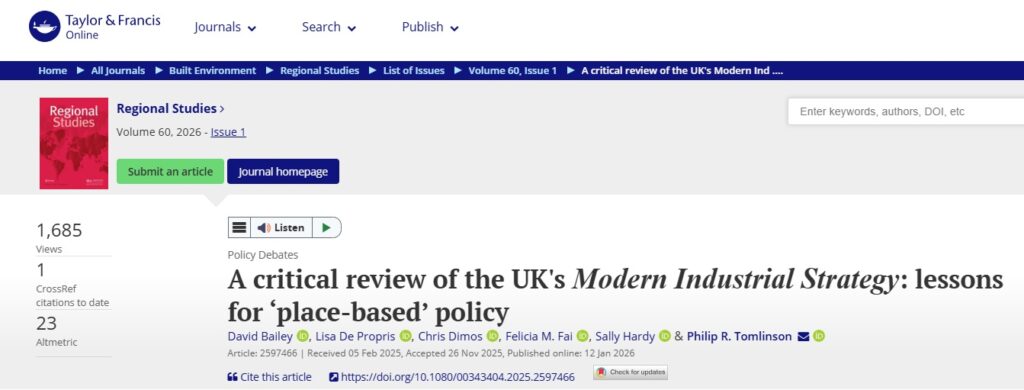
Bailey, D., De Propris, L., Dimos, C., Fai, F. M., Hardy, S., & Tomlinson, P. R. (2026). A critical review of the UK’s modern industrial strategy: Lessons for ‘place-based’ policy. Regional Studies. https://doi.org/10.1080/00343404.2025.2597466
Video