
By Anna Growe and Eva Purkarthofer
The special session “Governance and Imaginaries of Sustainable City Regions” at the RSA Winter Conference 2025 in London constituted a key working moment within the newly established open research network “Bridging Governance Gaps in City-Regions: Addressing Land Take and City-Region Building Through Comparative Research” (2025–2028) (see Figure 1).
Figure 1: Logo RSA Research Network Bridging Governance Gaps
Organised by Anna Growe and Eva Purkarthofer, the half-day session was designed to further refine the network’s thematic triangle:
(1) city-regions as functionally integrated spaces,
(2) planning to reduce land take in city-regions, and
(3) the perception of the city-region as a political-planning space for action.
At the core of the discussions was the guiding question of why existing governance structures in functionally integrated city-regions continue to fail in effectively reducing net land take despite growing strategic planning attention. Across the papers, the debate made clear that this failure cannot be attributed solely to institutional fragmentation or weak planning instruments. Rather, it emerges from the interaction between functional interdependencies, competing spatial imaginaries, scalar mismatches, and uneven governance capacities.
- Governance and spatial imaginaries: New vocabularies for city-regions
The first part of the session focused on how city-regions are conceptually, symbolically, and institutionally produced.
The opening paper by Phelps, Keil, Maginn, Matthews and Valler, “Planning with extended urbanization: Elements of a strategic spatial planning vocabulary,” shifted the discussion beyond traditional core city–hinterland dichotomies. By proposing concepts such as white space regions, edges, boundary objects, interstices, and coalescence, the paper introduced a strategic vocabulary better suited to the relational complexities of extended urbanisation. A particularly productive contribution for the network debate was the explicit linkage between physical settlement patterns and questions of social relations and distributive justice: the spatial question of what goes where was directly connected to the normative question of for whom and why.
This conceptual line was extended by Häfner and Growe, “City-Regional Transformation Through Cohesion, Canvas, and Constructs: A Comparative Analysis of Inter-Municipal Adaptation Processes in Germany,” which examined twelve German city-regions. The paper demonstrated how intermunicipal structures evolve through the interplay of supra-regional strategic frameworks and regionally embedded path dependencies over time. The notions of cohesion, canvas, and constructs proved especially relevant for the broader discussion because they frame city-regions not as fixed territorial containers but as processual institutional formations shaped through multiple governance orders over time (see Figure 2).
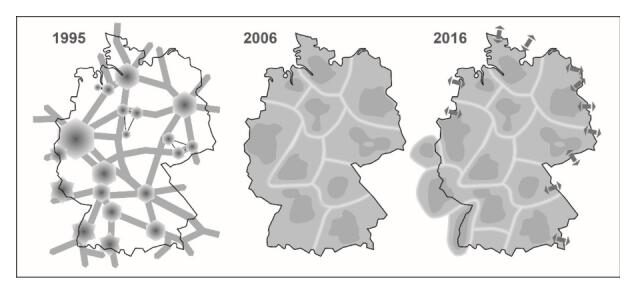
Figure 2: Changing Imaginaries of Metropolitan Regions in German Spatial Visions, Source: own visualisation
A more explicitly scalar and conflict-oriented perspective was introduced by Harrison, Lian, Gu and Wang, “‘Nine dragons rule the regions’: the challenge of integrated regional development in China,” which conceptualised overlapping national, provincial, metropolitan, and municipal spatial visions through the metaphor of the “nine dragons.” The proposed TPSN jigsaw approach was particularly valuable for the session’s comparative agenda, as it demonstrated that contradictions between planning scales are not anomalies but structural features of integrated regional development.
A finer-grained conceptual perspective on ambiguous metropolitan spaces was provided by Demuynck, Derudder, Meijers and Van Meeteren, “Between suburb and city: conceptualising interplaces,” which centred on hybrid localities that do not fit established city–suburb distinctions. The analysis of interplaces in the Brussels metropolitan area showed how such in-between spaces play critical economic, political, and cultural roles despite their conceptual ambiguity. These places emerged in the discussion as crucial sites where the contradictions of metropolitan governance materialise most visibly.
The governance implications of these debates were further sharpened by Mikuła, “From Flexibility to Formality: Rethinking Planning Governance for Managing Land Take in Polish City-Regions,” which analysed the ongoing transition of Polish city-regions from soft, voluntary cooperation towards hybrid governance arrangements combining informal collaboration with emerging statutory obligations. A central point of debate concerned whether increasing formalisation genuinely strengthens land take governance or merely adds new institutional layers without resolving scalar fragmentation.
- No net land take and urban–rural interrelations
The second part of the session shifted attention more explicitly towards land policy, peri-urban conflicts, and urban–rural interdependencies.
In Krassnitzer, “Regional planning for no net land take: Designing strategic planning processes in peri-urban Austria,” the design of strategic planning processes itself became the central analytical focus. The discussion particularly engaged with the argument that regional planning instruments must be understood not only as regulatory tools but also as creative, task-specific process designs capable of responding to peri-urban land-use conflicts.
A comparative governance perspective was offered by Morandell, “Urban-rural coordination in local planning: Comparing multi-level planning governance in the Brescia and Kassel city-regions,” which compared coordination arrangements in Brescia and Kassel. The paper demonstrated that successful coordination depends less on any single institutional model than on different combinations of institutional maturity, political leadership, trust, and long-term cooperative routines. For the network, this contribution was especially important in foregrounding medium-sized city-regions as an underexplored yet highly relevant scale of analysis.
A more explicitly rural transformation perspective was offered by Yan and Chen, “Rural transformation and multi-scalar livelihood strategies under city-regional environmental governance: Evidence from 43 villages in the Yangtze River Delta metropolitan region, China,” which examined how city-regional environmental governance reshapes rural livelihoods and institutional processes in metropolitan hinterlands. By identifying multiple livelihood pathways through fsQCA, the paper highlighted how environmental regulations, incentives, and organisational arrangements on the city-regional scale can deeply transform local development trajectories.
The interrelation between land policy and biodiversity governance was addressed by Baroková, “No net loss policies for biodiversity and land: synergies and trade-offs,” which explored the synergies and contradictions between no net land take and no net loss of biodiversity. The debate around this contribution focused particularly on the political ecology of offsetting: although both policy agendas rely on similar principles of avoidance, mitigation, and compensation, their implementation raises difficult questions regarding land scarcity, ownership interests, spatial equity, and the relocation of ecological compensation into peri-urban or rural areas.
- Core research debates and open questions
Across all papers, four major lines of debate emerged:
- the persistent governance gap between functional spaces and institutional jurisdictions
- the role of spatial imaginaries and narratives in shaping institutional change
- the tensions between voluntary cooperation, hybrid arrangements, and legal formalisation
- the challenge of implementing land and biodiversity targets in spatially just ways
A particularly productive shared insight was that city-regions cannot be understood solely as functional economic spaces or as administrative tiers. Rather, they emerge through the interaction of material interdependencies, political imaginaries, institutional experimentation, and contested governance practices.
The discussions also highlighted several open questions for comparative research: How can hybrid governance arrangements be conceptualised beyond the soft space/formal space binary? Which intermediary spaces—interplaces, peri-urban corridors, white spaces—become decisive for future land governance? And how can offsetting and compensation mechanisms be designed in ways that are ecologically effective while remaining spatially and socially equitable?
- Future research activities in an open network
The London session explicitly functioned as a working platform for the next phase of the network’s activities (see Figure 3). Several promising research strands emerged from the debate:
- comparative analyses of hybrid governance arrangements between soft and formal spaces
- the role of intermediary spaces (interplaces, peri-urban corridors, white spaces) in land governance
- spatial justice and offsetting mechanisms in city-regions
- urban–rural interdependencies under environmental and climate governance regimes
- institutional innovation in medium-sized functionally integrated regions
- the translation of spatial imaginaries into strategic planning instruments
The network remains explicitly open to additional scholars and practitioners from planning, geography, political science, environmental governance, and related disciplines. In particular, early career researchers are warmly invited to contribute theoretical, empirical, or methodological perspectives to the upcoming activities.
The core strength of the network lies in bringing together diverse regional contexts, methodological approaches, and disciplinary perspectives in order to advance the question of sustainable city-regional development through a relational and comparative lens.
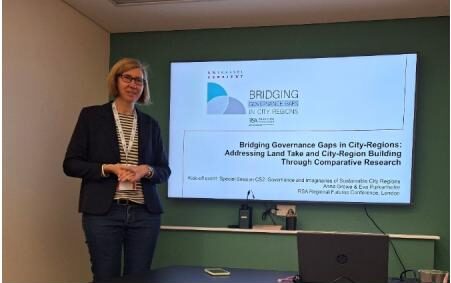
Figure 3: Anna Growe introducing the Research Network. Photo by Eva Purkarthofer.