

By Zihan Wang, Felicia M Fai, Philip R Tomlinson, Mariachiara Barzotto and Beate Ehrhardt
In a recent article published in Regional Studies, we explore the potential role of coworking spaces (CWSs) as vehicles for local skills development in the UK; mechanisms that extend beyond conventional, formal policy frameworks on skills and education systems.
The country’s skills system has historically relied on highly centralised models of formal education and training. Regional skill gaps remain a persistent challenge in the UK, despite decades of policy intervention. Universities, further education colleges, and vocational programmes remain the dominant channels through which skills are developed. However, their largely top-down design, combined with an emphasis on formal qualifications over timely and practical capabilities, has attracted increasing criticism and renewed calls for more flexible and place-based approaches.
Informal learning processes within coworking spaces
The potential of CWSs to support skill development lies in their distinctive organisational characteristics. Unlike traditional workplaces, CWSs bring together individuals from diverse organisations, industries and professional backgrounds within a shared environment. In these settings, organisational boundaries are softened, enabling informal networking, interpersonal exchange and collaboration among individuals who might not otherwise interact.
Such interactions foster localised collective learning, shaped by diverse knowledge bases and experiences. Through these everyday exchanges, coworkers may develop social-cognitive skills, including communication, collaboration, and creative problem-solving.
At the same time, CWSs may also support technical-digital skill development through access to shared resources. Many CWSs provide advanced equipment, specialised software, and targeted training opportunities that may otherwise be inaccessible to freelancers and small firms. Workshops, hackathons and peer-led sessions further encourage hands-on learning and experimentation with new technologies, facilitating the development of practical, work-relevant technical-digital skills that are closely aligned with current industry practices.
Taken together, these two mechanisms suggest that CWSs may offer a pathway for skill development that complements formal education and training systems (see Figure 1).
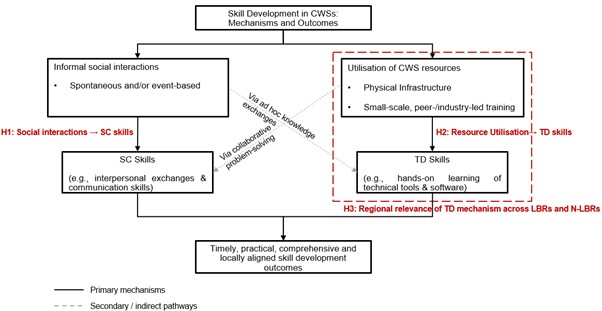
Figure 1. Theoretical framework of skill development in coworking spaces.
From coworking to regional skills development: evidence from across the UK
Driven by the rise of hybrid working and a growing preference to work closer to home, CWSs have expanded beyond major urban centres into peripheral, rural and coastal areas – often referred to as left-behind regions. This geographical diffusion means their role may extend beyond individual skill development to shaping broader regional skill dynamics.
Drawing on a survey of managers and coworkers from 161 CWSs across 74 UK regions, we examine how CWSs contribute to the development of both social-cognitive and technical-digital skills, and how these effects vary across regional contexts.
Our findings show that CWSs are indeed associated with the development of both social-cognitive and technical-digital skills. Specifically, social interaction within CWSs (including spontaneous networking and community events) is positively associated with the development of social-cognitive skills such as collaboration and adaptability. Meanwhile, the utilisation of CWS resources (including physical infrastructure and targeted training opportunities) is positively associated with the development of technical-digital skills, such as proficiency in digital tools, programming, and data analysis.
Importantly, these mechanisms operate differently across regional contexts.
In socio-economically left-behind regions, coworkers benefit particularly from structured resources provided by CWSs in developing technical-digital skills, acting as key access points for tools, technologies and training provision opportunities that may otherwise be unavailable locally to entrepreneurs, helping to compensate for weaker institutional capacity. At the same time, organised training and collective learning within CWSs can also foster collaboration, communication and problem-solving, contributing to the development of social-cognitive skills.
By contrast, in more advanced regions technical-digital skills development tends to emerge more organically through informal, bottom-up social interactions, and less from formal structured provision. Denser local networks foster richer knowledge exchange and more effective co-learning opportunities, supporting the development of social-cognitive skills. Combined with closer proximity to the technological frontier, these conditions also enable technical-digital skills to develop more organically through everyday interactions.
Implications for place-based skills policy
These findings carry important implications for place-based skills policy. They highlight the potential of CWSs as flexible, local vehicles for skill development across different regional contexts.
In left-behind regions, in particular, CWSs offer a flexible, place-based vehicle for piloting small-scale, locally tailored technical-digital training initiatives, helping to mitigate the negative impacts of longstanding digital divides. This could include investment in digital infrastructure, support for targeted training programmes, and the development of partnerships between CWSs, universities, and local employers. If shown to be effective, interventions could be gradually scaled up to more deeply integrate CWSs into local skills policy discussions.
In more advanced regions, policy efforts may instead focus on leveraging CWSs as centres for enhancing social connectivity and knowledge exchange mechanisms within CWSs, facilitating ‘weak ties’ connections that can aggregate into rich pools of social capital.
At the same time, CWSs are not a panacea for addressing the shortcomings of broader UK skills policy or resolving longstanding regional skill imbalances. As a relatively new and still small-scale phenomenon, they are used by only a relatively small proportion of the working-age population. However, within a broader package of place-based skills policies, they exemplify the potential of local vehicles that can facilitate collaborative activities, enhance knowledge exchange, strengthen local networks, offer targeted training opportunities, and bring together a wide array of stakeholders in the local skill development process.
More broadly, our findings point towards a shift in how skills policy might evolve. Rather than relying solely on formal education and training on apprenticeship schemes etc, an effective place-based skills policy may need to incorporate a wider range of local vehicles and informal learning mechanisms. In this sense, CWSs highlight three key principles for future skills policy: it must be locally embedded, flexible in design, and comprehensive in scope.
Further reading
Wang, Z., Fai, F. M., Tomlinson, P. R., Barzotto, M., & Ehrhardt, B. (2026). Coworking spaces: a place-based approach for skill development in left-behind regions. Regional Studies, 60(1). https://doi.org/10.1080/00343404.2026.2639508