
By Fleur Gontie, Ilyas Benchaqroudi, Khaska Said, Luca Mortier and Prof Dr Pablo Collazzo, Business & Tourism Unit, Thomas More University of Applied Sciences, Belgium*.
The “Parisian brand” is one of the most recognisable place brands in the world, synonymous with cultural prestige and elite hospitality. Yet behind the postcard, the Île-de-France hospitality cluster is a mature urban economy under mounting structural strain. In 2024, the region received 48.7 million international visitors, and hotel occupancy averaged 82.6% across the first three quarters of 2025 (CCI Paris-IDF, 2025). These are the kind of numbers most tourism regions would envy and precisely the kind that, in a fixed urban footprint, start to erode the very brand equity they generate.
For regional policymakers elsewhere, Paris is a useful test case. It shows what happens when a cluster shifts from a growth-oriented strategy to a defensive stabilisation strategy, managing the tension between global prestige and residents’ quality of life. Left unmanaged, that tension produces what is increasingly termed “tourism gentrification”: the slow substitution of everyday urban life with tourist-facing consumption. The Île-de-France response, combining legislative reform, circular-economy innovation, and a distinct approach to workforce and service strategy, offers transferable lessons for other saturated tourism hubs, from Barcelona to Amsterdam to Venice.
A stable macroeconomic base and a cluster carrying two anchors
The cluster’s resilience rests on a relatively stable national macroeconomic backdrop. French public debt is projected to reach around 120% of GDP by 2027, yet real GDP growth is still expected to climb from 0.6% in 2025 to 1.2% in 2027, with headline inflation held near 1.0% by weak energy prices though “core” inflation (excluding energy and food) remains stickier at close to 1.9%, reflecting continued service-sector cost pressure (Banque de France, n.d.). This is not a booming economy, but it is a stable enough one to support multi-year hospitality investment.
Institutionally, the cluster is unusual in dividing its “anchor” role in two, a distinction worth attention from a governance perspective. Accor, headquartered in Paris, functions as a corporate anchor: a global benchmark for digital transformation and sustainability practice, but not a coordinating body. Coordination instead falls to Paris je t’aime, the Paris Convention and Visitors Bureau, working with the Paris Region Chamber of Commerce as an institutional anchor aligning roughly 1,626 hotels and 87,016 rooms across the region, particularly around major international events (Cci-Paris-IDF, 2025). This split matters: it is a reminder, familiar from the place-branding literature, that a strong destination brand is rarely the product of a single dominant firm but of ongoing coordination among multiple public and private actors with partially overlapping interests (cf. Kavaratzis, 2004; Zenker & Braun, 2010). Seen through a strategic spatial planning lens, this is precisely the kind of institutionally embedded, multi-scalar coordination problem that place-branding scholarship has argued cannot be resolved by a single anchor firm or agency acting alone, but depends on sustained alignment between public planning bodies and private actors across spatial scales (Oliveira, 2016).
The scale of Paris’s advantage over other French regions bears this out empirically, but with an interesting wrinkle. On a composite competitiveness matrix weighted across five criteria, Île-de-France scores 4.93 out of 5.0, against 3.58 for Nouvelle-Aquitaine (Bordeaux), 3.38 for Provence-Alpes-Côte d’Azur (Nice), and 2.53 for Occitanie an advantage underpinned by a 12th-place global innovation ranking and €564 billion in inward FDI (28% of national GDP) in 2023 (authors’ analysis, based on Insee 2025 regional data; “France,” 2022). Disaggregating the matrix by criterion, however, shows that this lead is not uniform across criteria. Paris’s widest margin is on economic significance, where it outscores its nearest rival by a full two points; its narrowest margin, a mere half-point over Bordeaux, is on governance and collaboration (Figure 1). That is a useful, slightly uncomfortable complement to the anchor-split argument above: institutional coordination is a real source of Paris’s advantage, but it also appears to be the least structurally “locked in” of the five criteria. Economic mass and accessibility are close to unassailable for competitor regions; governance, in principle, is learnable and replicable elsewhere.
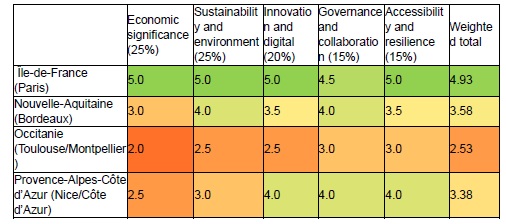
Figure 1. Île-de-France’s competitive edge is broad but not uniform: a five-criteria comparison of French tourism regions. Scores run from 1 (weakest) to 5 (strongest) across five weighted criteria. Economic significance (25%), Sustainability & environment (25%), Innovation & digital (20%), Governance & collaboration (15%), and Accessibility & resilience (15%). Île-de-France leads on every dimension, but its narrowest margin, over Nouvelle-Aquitaine (Bordeaux), is on governance & collaboration, the one criterion most dependent on institutional coordination rather than fixed endowments.
The legislative pivot
Much of this advantage is now being actively defended through regulation. France’s so-called “Anti-Airbnb” legislation reduces tax benefits for short-term rental owners, tightens rental-duration limits for primary residences, and imposes mandatory DPE energy-efficiency standards on unregulated rentals, bringing them closer to the compliance burden already carried by professional hotel stock (Masson, 2025). The underlying policy logic is straightforward: unregulated short-term letting diverts housing from residents to tourists, and France has treated this as a housing-market distortion serious enough to warrant statutory correction (Masson, 2025).
For traditional operators, the legislative shield has prompted a second, more interesting response: a retreat toward professionalism as a competitive strategy in its own right. Hotels are increasingly positioning security, service consistency, and “human-centric” hospitality as the value proposition that platforms cannot replicate. It is a workable strategy but one that runs directly into the cluster’s most persistent weakness: sustaining a high-touch service model amid a chronic labour shortage.
The automation paradox
Here, the Paris case departs from a common assumption in tourism-technology research that automation is a straightforward solution to labour shortages. Interview evidence gathered for this study (Ksenia Kirillova, personal communication, October 2025) suggests the opposite dynamic in the Parisian 4-star and “Palace” segments: automation and AI are read by guests as signals of lower quality rather than efficiency. A generational shift is compounding this. Younger travellers (Gen Y/Z) increasingly consume hospitality according to shared values and “lifestyle” affiliation rather than income bracket, a trend Accor’s own JO&JOE concept has tried to capture by blurring the line between hostel and hotel around social connection rather than luxury per se.
The practical implication is counter-intuitive for planners used to thinking of automation as a labour-shortage fix: in markets where “cultural authenticity” and person-to-person service are themselves the premium product, occupancy bottlenecks are not something technology can easily solve. This reframes the 82.6% occupancy rate less as a capacity problem and more as an argument for participative, less hierarchical management structures that can attract and retain skilled staff in a high-cost city, a shift interviewees describe as already underway, if incomplete. It also lends empirical weight to a point long made in the place-branding literature: that “authenticity” is not a fixed asset a destination simply possesses, but a narrative co-constructed in real time through the interactions between hosts, visitors, and place (Oliveira, 2016). Automating away the human interaction, in that sense, does not just remove a service cost; it removes part of the mechanism by which the brand itself is produced.
To meet 2030 regional climate targets, the cluster’s ageing infrastructure, a repeatedly cited weakness, needs to become an asset rather than a liability. The report this article draws on proposes a Paris Circular Hospitality Exchange (PCHE), envisioned as an operating layer across three pillars:
- Zero waste and sustainable materials, a “Green Certification for IDF Hospitality” built around design-for-disassembly principles and reclaimed materials in renovation.
- Low-carbon transport integrating RATP/SNCF services and bike-sharing (Véligo) directly into visitor packages.
- Innovation and green tech: a “Hospitality Innovation Lab” connecting clean-tech startups with established hotel groups.
The mechanism intended to make this stick is a system of “Circular Credits”: hotels that exceed environmental benchmarks earn credits redeemable against green funding or subsidised renovation grants, converting sustainability compliance from a cost into an incentive.
What makes the PCHE worth more than a green-policy footnote is what it does to the cluster’s competitive position, not just its carbon footprint. In Porter’s cluster framework the analytical backbone of the Microeconomics of Competitiveness course from which this project originates a region’s productivity depends as much on the depth and sophistication of its related and supporting industries as on its core firms (Porter, 1998). Today, waste management, recycling, and clean-tech provision sit at the periphery of the Île-de-France hospitality cluster: fragmented, uncoordinated, and largely invisible to the hotels they serve. The PCHE’s proposal to broker shared circular infrastructure, one composting operator, one textile-upcycling partner, one food-redistribution channel, negotiated once on behalf of the whole cluster rather than hotel-by-hotel, is, in competitiveness terms, an upgrading strategy for exactly this weak link in the diamond. It converts a dispersed supplier base into a coordinated one, which is precisely the kind of institutional thickening that distinguishes a mature cluster from a merely large one.
The Circular Credits mechanism does a second piece of competitiveness work: it re-prices sustainability compliance as a source of differentiation rather than a shared cost. This is not a new idea in principle. Porter and van der Linde (1995) argued three decades ago that well-designed environmental standards can drive innovation offsets that improve, rather than erode, competitive position, but it is rarely operationalised at cluster scale in tourism. If credits are genuinely redeemable against financing, the PCHE effectively turns the EU’s regulatory push toward decarbonisation into a firm strategy and rivalry lever: hotels that move first on circularity gain both a cost advantage (subsidised renovation) and a demand-side one (guests increasingly filtering for sustainability credentials, even if as the interview evidence in the underlying report suggests they remain reluctant to pay a premium for it). For a cluster whose ageing rail and building stock has been flagged as a structural weakness, that reframing matters: it is one of the few levers on the table that improves both environmental performance and long-run cost competitiveness at the same time, rather than trading one against the other.
Its success, in short, is a governance question as much as a technical one; it depends on whether the institutional anchor (Paris je t’aime) can broker it across a highly fragmented ownership base of SMEs, independents, and multinational chains alike, each with different appetites for upfront investment against a shared, cluster-wide payoff (Figure 2).
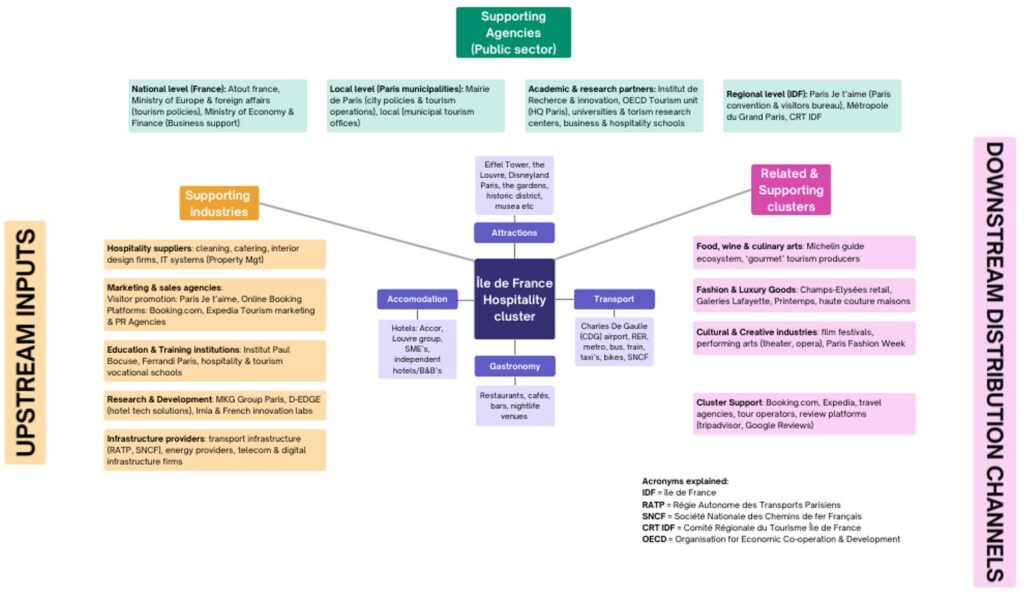
Figure 2: The Paris Hospitality & Tourism cluster mapping (Authors’ elaboration, 2025)
Applied implications for regional practice
Three actionable directions follow for planners in comparably saturated destinations:
- Build a unified talent pipeline. A “Paris Hospitality Skills Hub” connecting vocational schools (Ferrandi, Institut Paul Bocuse) directly with employers would formalise what is currently an ad hoc collaboration.
- Subsidise the workforce, not just the visitor. Housing and transport subsidies for hospitality staff address tourism gentrification from the labour side, not only the housing side.
- Consider a growth cap, not just a service-quality argument. An “Amsterdam-style” cap on new hotel development is worth serious evaluation as a complement to the professionalisation strategy; the two are not substitutes.
Conclusion
Paris is arguably one of the clearest global test cases for a proposition that will increasingly matter to saturated urban tourism economies: that competitiveness and volume growth are not the same thing, and that, at some point, protecting a place brand requires choosing to limit it. The Anti-Airbnb legislation and the Paris Circular Hospitality Exchange proposed here are two sides of the same wager that Paris can defend both its residential fabric and its elite hospitality heritage without simply chasing more visitors. Whether that wager pays off, and whether it is replicable in cities with weaker institutional coordination than Paris enjoys, is the open question for the next decade of tourism governance research. The Parisian strategy provides a global blueprint for managing the tension between economic growth and sustainable quality of life. By choosing to limit hotel development and strictly regulate short-term rentals, Paris is asserting that for a premier brand, “more” is not “better.”
References and further readings
Banque de France. (n.d.). Macroeconomic projections – June 2025.
BVRio / Circular Action Hub. (n.d.). Circular Credits Mechanism.
CCI Paris Île-de-France. (2025). Paris Region facts & figures 2025.
Circular Action Hub. (2021). Guidelines on best practices for the Circular Credits Mechanism.
Kavaratzis, M. (2004). From city marketing to city branding. Place Branding, 1(1).
Masson, T. (2025). France anti-Airbnb law: What it means for vacation rentals. RSU by PriceLabs.
Oliveira, E. (2016). Place branding in strategic spatial planning: An analysis at the regional scale with special reference to Northern Portugal [PhD thesis, University of Groningen].
Porter, M. E. (1998). Clusters and the new economics of competition. Harvard Business Review, 76(6), 77–90.
Porter, M. E., & van der Linde, C. (1995). Toward a new conception of the environment-competitiveness relationship. Journal of Economic Perspectives, 9(4), 97–118.
Zenker, S., & Braun, E. (2010). The Place Brand Centre: A conceptual approach for place branding and place brand management. In Proceedings of the 39th European Marketing Academy Conference.
*Note
This article is a reflective summary of a comprehensive academic work titled “Definition of the Parisian Hospitality Cluster”, developed by Fleur Gontie, Ilyas Benchaqroudi, Khaska Said, and Luca Mortier, now graduates of the International Business and Trade programme, under the supervision of Dr Eduardo Oliveira and Prof. Dr. Pablo Collazzo at the Business & Tourism Unit of Thomas More University of Applied Sciences, Mechelen, Belgium.
Professor Pablo Collazzo has been instrumental in introducing business schools worldwide to the MOC network and guiding them in implementing MOC classes and related research activities, including at Thomas More University of Applied Sciences. The Microeconomics of Competitiveness (MOC) is a distinctive course platform developed at Harvard Business School by Professor Michael Porter and colleagues at the Institute for Strategy and Competitiveness.
Correspondence concerning this article should be addressed to Dr Eduardo Oliveira (e-mail). The students’ work is available upon request from Dr Oliveira.