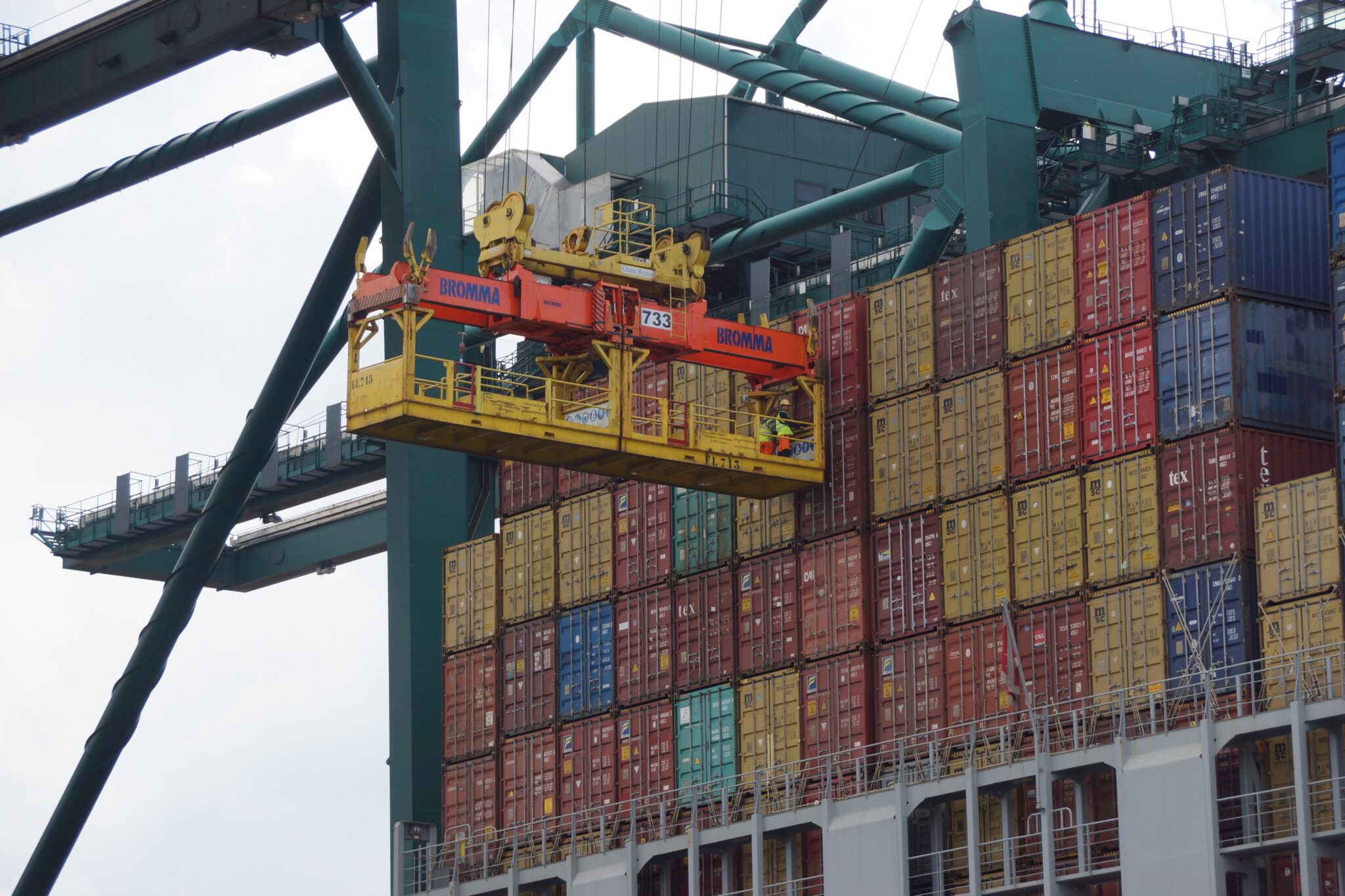

On the Waterfront: RSA Research Network on Infrastructural Regionalism (NOIR) Workshop puts port regionalism in the dock
By Dr. Jean-Paul Addie (email), Urban Studies Institute, Georgia State University (USA), Dr. Jen Nelles (email), Oxford Brookes University Business School (UK) and Dr. Michael Glass (email), Urban Studies Program, University of Pittsburgh (USA)
About NOIR
The RSA Research Network on Infrastructural Regionalisms (NOIR) challenges regional studies to address infrastructural questions by critically unpacking how infrastructure shapes regional lives, governance, and developmental pathways. Our conceptual framing of ‘infrastructural regionalism’ focuses on those infrastructures that have relevance beyond the local. Analysing regions through infrastructure provides a novel perspective on the regional question, as investment and disinvestment in infrastructure reveal vital discursive and material elements that produce, structure, and modify metropolitan regions worldwide. The development of infrastructural assets – ranging from transport and telecommunications to energy and sanitation – as part of regional policies raises conceptual and applied questions about how the funding, governance, and spatiality of such infrastructure can promote urban, economic, and ecological sustainability at the regional scale.
NOIR’s Aims:
- Showcase theoretically informed, empirically grounded research at the intersection of infrastructure studies and regional studies.
- Promote the formation of collaborative, interdisciplinary, and comparative research teams to stake out and mobilize new research agendas at the intersection of infrastructure and the region.
- Foster novel scholarship through senior/junior scholar and academic/practitioner exchanges at RSA network events.
- Promote information exchanges that can inform regional development policies.
Report: On the Waterfront- NOIR Workshop puts port regionalism in the dock
The Port of Antwerp dates back to the Middle Ages, reaching its first zenith during the 16th-century Golden Age when it served as Europe’s leading commercial and financial center, rivaling maritime powers like Venice and Lisbon. Today, following its strategic 2022 merger with the Port of Zeebrugge to form the unified Port of Antwerp-Bruges, it is Europe’s second-largest seaport and its largest export hub. Functioning as a vital node in global shipping networks, the modern port handles between 271 and 290 million tons of international maritime cargo annually, offers liner services to over 800 destinations, and is home to the largest integrated chemical cluster in Europe (Port of Antwerp 2026). Given its unique inland location provides deep hinterland connectivity via rail, road, and extensive waterway networks, Antwerp was a fitting place to gather an interdisciplinary group of scholars from universities in nine countries (and conducting research across the globe) to discuss infrastructural regionalism with a focus on ports.
The concept of infrastructural regionalism, developed through the RSA Network on Infrastructural Regionalisms (NOIR), offers a distinctive lens to rethink how infrastructure shapes not only physical landscapes but also the political and social construction of regional space at a variety of scales (Addie et al., 2020; Glass et al., 2019; Glass et al., 2023). NOIR’s approach encourages interdisciplinary engagement and explorations of cross-border competition and collaboration, alongside attention to the insights gleaned from ‘seeing like a region’ and centering the lived experience of regional space. In exploring port regionalisms from this analytical vantage point, the workshop, held 8-9 June 2026 at the Urban Studies Institute, University of Antwerp, aimed to interrogate infrastructural and regional dynamics in peripheral as well as metropolitan regions, building new conceptual tools and opening the conversation to different problematiques of governance, planning, policy, and politics.
The workshop presented participants with a series of prompts designed to provoke conversation at the intersection of NOIR’s core interests and port geographies:
- Port city-regional governance: What governance structures, institutions, and actors define port regions, and how do they interact? How do infrastructural entanglements challenge or reinforce regional governance and planning? How do public and private interests converge or clash?
- Material politics of port infrastructure: How do ports co-constitute their urban and regional contexts? How do physical systems (e.g., dredging, container terminals, intermodal links) and network geographies shape regional dynamics?
- Regional logistics geographies: What roles do supply chains, data flows, and automation play in regional integration and fragmentation? How do port labor regimes reflect and reshape regional economies, for instance, through labor regimes, containerization, and the regionalization of work?
- Environmental governance and resilience: How do ports, as sites of infrastructural vulnerability and adaptation, manage ecological impacts across regional scales?
- Temporalities of infrastructure: How do daily rhythms and extended timescales of port maintenance, obsolescence, and development co-constitute regional space? Who envisions regional port futures, using what tools, and over what timeframes?
- Lived port regions: What does it mean to live in a region shaped by port infrastructure? How do communities experience, resist, or reimagine these spaces? Who claims legitimacy in these spaces? How are everyday lives in port regions shaped by processes of territorial regulation and securitization?
Building from these provocations participants examined how key stakeholders and communities within regional envelopes leverage the presence of port infrastructures and pursue infrastructure‑based investments to shape desired regional futures. Conversations also addressed the circumstances of regions that are defined by port infrastructures and flows yet remain disconnected from their material benefits, as well as port cities and regions that are effectively “left behind” by the spatial concentration of high‑value commodity transformation. Participants further considered cases in which communities – whether rural communities in Flanders or female laborers in Felixstowe – become marginalized due to their conscious opposition to the forms of transformation that infrastructure can compel.
A central strength of the workshop was the deliberate space created for substantive intellectual exchange among researchers working from diverse analytical traditions, across multiple scales, and in varied global contexts. Presentations were diverse, introducing topics including port’s roles in constructing territorial imaginaries, their experience evolving through energy transitions, inland port infrastructures, transnational power geometries, grassroots activism, and port governance, among others and covered case studies on four continents, taking us from Antwerp and Zeebrugge to Mombasa, Anaklia, and Singapore – and back . Specific research panels facilitated reflective conversations that traversed conceptual, methodological, and political vantage points, allowing participants to interrogate assumptions and identify productive tensions.
Through these interdisciplinary dialogues, the workshop highlighted how port regionalism is actively reconfiguring contemporary port‑city relations through the transformation of port infrastructures, evolving governance arrangements, and increasingly regionalized entanglements. Yet across cases, a persistent paradox emerged: port authorities themselves are rarely regional. Ports operate through multi‑scalar, multi‑actor governance, but regional governance remains the weakest link. Inland logistics hubs and distribution centers are typically sited through local real‑estate logics rather than coordinated regional planning, producing a governance mismatch in which regional impacts emerge without corresponding regional institutions capable of addressing them. This gap underscores the need for analytical approaches that can capture the relational and territorial complexities of port‑infrastructure systems.
Participants emphasized that ports and their hinterlands tend to function as regions produced through flows, corridors, logistics networks, and interdependencies rather than through formal political boundaries. Understanding portscapes therefore requires learning to see “like a region”—to apprehend the infrastructural, socio‑ecological, and economic dynamics that exceed municipal or national jurisdictions. Crucially, infrastructural regions are not only sites of global connectivity, trade, and capital; they are also arenas of protest, counter‑geographies, and everyday life. Bringing NOIR’s thematic attention to regional lives into conversations around port regionalism offers a fruitful pathway for integrating social movements, everyday resistance, and distributive justice into the analytical core of port‑infrastructure research.
Overall, the workshop illuminated the deep interconnections between infrastructure, governance, and global economic systems as they are assembled through regional port spaces. It showcased the transformative potential of port infrastructures while also revealing the tensions, contradictions, and uneven impacts embedded in their development and management. The discussions underscored that port infrastructure is never merely physical; it is political, economic, and social, shaping regional and global landscapes in profound ways. By foregrounding these dynamics, the workshop advanced NOIR’s agenda and opened new avenues for theorizing and researching infrastructural regionalism through the lens of port systems.
The NOIR workshop on port regionalism catalyzed a wide‑ranging interdisciplinary conversation at the intersection of infrastructural regionalism, port and logistics studies, critical infrastructure studies, and spatial planning research. By bringing these communities into dialogue, the workshop advanced NOIR’s commitment to developing analytically rich and empirically grounded approaches to understanding how regional dynamics shape, and are shaped by, contemporary port infrastructures. Our discussions demonstrated how the developing framing of port regionalism offers a productive lens for examining multi‑scalar governance, territorial reconfiguration, and the socio‑technical systems that underpin global circulation in new and illuminating ways.
Looking ahead, NOIR’s leadership team will continue collaborating closely with workshop contributors to refine and extend the working papers presented during the event. This collective effort will culminate in a special issue for Regional Studies (currently in the proposal phase). We invite interested researchers to get in touch and follow along as this project develops.
References
Addie, J.-P. D., Glass, M. R., and Nelles, J. (2020). Regionalizing the infrastructure turn: A research agenda. Regional Studies, Regional Science, 7(1), 10-26.
Glass, M. R., Addie, J.-P. D., and Nelles, J. (2019). Regional infrastructures, infrastructural regionalism. Regional Studies, 53(12), 1651-1656.
Glass, M. R., Nelles, J., and Addie, J.-P. D. (2023). On fetishes, fragments ad futures: Regionalizing infrastructural lives. In A. Wiig, K. G. Ward, T. Enright, M. Hodson, H. Pearsall, and J. Silver (Eds.), Infrastructuring urban futures: The politics of remaking cities (pp. 188-198). University of Bristol Press.
Port of Antwerp (2026) World Port https://www.portofantwerpbruges.com/en/our-port/world-port