

By Bernardo Buarque, Pablo Casas, Enrique Fernández-Macías, Ignacio González-Vázquez, Ryan Hynes, Dieter F. Kogler, and Simone Salotti
Reference to the original article published in Regional Studies:
Buarque, B., Casas, P., Fernández-Macías, E., González-Vázquez, I., Hynes, R., Kogler, D. F., & Salotti, S. (2026). The geography of artificial intelligence in European regions: innovation, exposure and use. Regional Studies, 60(1), 2681659. https://doi.org/10.1080/00343404.2026.2681659
The digital transition is frequently presented as a borderless revolution capable of lifting all economic ships regardless of geography, with Artificial Intelligence (AI) at its forefront. Yet, beneath this rhetoric lies a deeply uneven geographical reality. Will AI act as a great equalizer across Europe, or will it reinforce existing cumulative advantages, widening the gap between leading hubs and lagging regions?
Our recent study maps the spatial distribution of AI across European Union NUTS-2 regions using six complementary indicators of AI innovation, occupational exposure, and actual use. Our findings reveal a striking spatial paradox: while exposure to AI and worker-level use are remarkably widespread, the actual production of frontier AI knowledge and structured firm-level implementation remain concentrated in a small number of high-income hubs.
Deconstructing the AI Ecosystem: Innovation, Exposure, and Use
No single indicator can capture how AI interacts with regional economies. We therefore distinguish three components:
- AI Knowledge Production (Innovation): Using European Patent Office (EPO) data, we identify more than 27,000 AI-related patent families. Beyond patent counts, we compute the Artificial Intelligence Centrality Index (AICI, Buarque et al., 2020), a network-based metric of whether AI is merely an isolated niche or a structural component of a region’s broader technological fabric.
- Occupational Exposure: This measures the structural susceptibility of local labor markets to AI systems. We compare a research-based index, which maps jobs to advanced scientific benchmarks (Tolan et al., 2021), with an expectation-based index reflecting near-term application capabilities (Felten et al., 2021). Both identify which regional workforces perform the cognitive and analytical tasks closest to current AI capabilities.
- Actual Economic Use: Technical proximity does not guarantee deployment. Hence, we measure actual uptake through two direct lenses: self-reported AI use by individual workers (González-Vázquez et al., 2025) and formal firm-level adoption metrics harmonized by Eurostat.
The Spatial Paradox and the Implementation Gap
When these six indicators are mapped onto European territory, a profound asymmetry emerges. AI innovation is highly skewed. A tiny cluster of Central and Western European regions, predominantly located in Germany, France, Sweden, the Netherlands, and Northern Italy, accounts for the bulk of AI patent applications and hosts the most deeply embedded AI knowledge systems. This clustering is consistent with insights from Evolutionary Economic Geography: AI innovation thrives where pre-existing digital, software, and ICT capabilities are already dense.
The AICI reveals crucial regional variations that raw patent counts miss. For instance, a region like Helsinki might not match the volume of patent applications seen in massive German manufacturing clusters, yet it boasts an exceptionally high AICI score. This demonstrates that its AI breakthroughs are thoroughly interconnected with other regional capabilities, branching dynamically into logistics, robotics, and medical diagnostics.
In contrast, occupational exposure is far more evenly distributed. Highly exposed workforces, dominated by professional, technical, managerial, and financial roles, are common across Northern and Central Europe, extending well beyond the main patenting hubs.
This mismatch points to a persistent regional implementation gap. High structural exposure does not mechanically translate into productive firm-level use. Many workers are already integrating AI tools into everyday tasks, often ahead of formal firm-level strategies, while organisational adoption is held back by institutional, organisational and capability-related frictions.
Macroeconomic Realities: Income, Skills, and Trade
To explore what drives these geographic distributions, we analyzed the relationship between our six AI indicators and core regional macroeconomic fundamentals, yielding several eye-opening insights. First, income (GDP per capita) is positively and consistently associated with AI activity across all six dimensions. Second, human capital: educational attainment is strongly linked to labor market exposure, but its relationship with raw patent production or corporate adoption is notably weaker. This implies that while a well-educated population dictates a region’s occupational structure, human capital alone is insufficient to trigger local frontier innovation or organizational uptake without a complementary corporate ecosystem. Third, trade openness exhibits a negative correlation with AI patenting and exposure. This indicates that Europe’s emerging AI economy is fundamentally service-oriented and knowledge-intensive, rather than anchored in traditional, export-driven manufacturing bases. It also reflects Europe’s current structural position primarily as an importer and user of AI applications rather than a primary exporter of core AI hardware and software.
Policy Imperatives for an Inclusive AI Transition
Left completely unmanaged, market forces will allow AI to exacerbate regional divergence, concentrating high-value economic gains in existing powerhouse hubs while leaving peripheral regions structurally exposed to displacement without the tools to capture productivity growth. Current EU strategies, such as the AI Act or digital strategy packages, rightly focus on regulation and baseline innovation, but are largely non-spatial in design and should be complemented with an explicit regional lens, along three directions:
- Building Cross-Regional Pipelines: EU Cohesion Policy and industrial strategies could actively bridge the geographical divide. Rather than attempting to replicate Silicon Valley in every region, funding should support collaborative networks that explicitly link frontier AI innovation hubs with specialized regions that possess domain expertise (such as smart agriculture, regional health services, or climate mitigation) but lack native AI development capabilities.
- Targeting Organizational Readiness: For lagging regions where exposure is high but formal adoption is low, Smart Specialisation Strategies could prioritize building organizational capacities, updating management practices, and subsidizing digital infrastructure. Closing the implementation gap requires helping local small- and medium-sized enterprises (SMEs) transition from informal worker experimentation to structural, productive AI integration.
- Inclusive Workforce Re-skilling: Because occupational exposure often signals opportunities for task augmentation and reorganization rather than immediate replacement, regional training systems should adapt. Educational programs should focus equally on basic digital literacy, critical evaluation of AI outputs, and non-automatable soft skills, ensuring that the benefits of AI augmentation are shared equitably across different tiers of the workforce.
Looking Ahead
Our regional mapping offers a snapshot of a fast-moving target. As generative AI continues its rapid, pervasive diffusion, tracking the evolution of these spatial patterns will remain a vital task for researchers and policymakers alike. By moving past abstract generalizations and addressing the granular, place-based realities of the digital transition, European policy can ensure that AI serves as a powerful engine for territorial upgrading and inclusive growth, rather than a deeper axis of regional inequality.
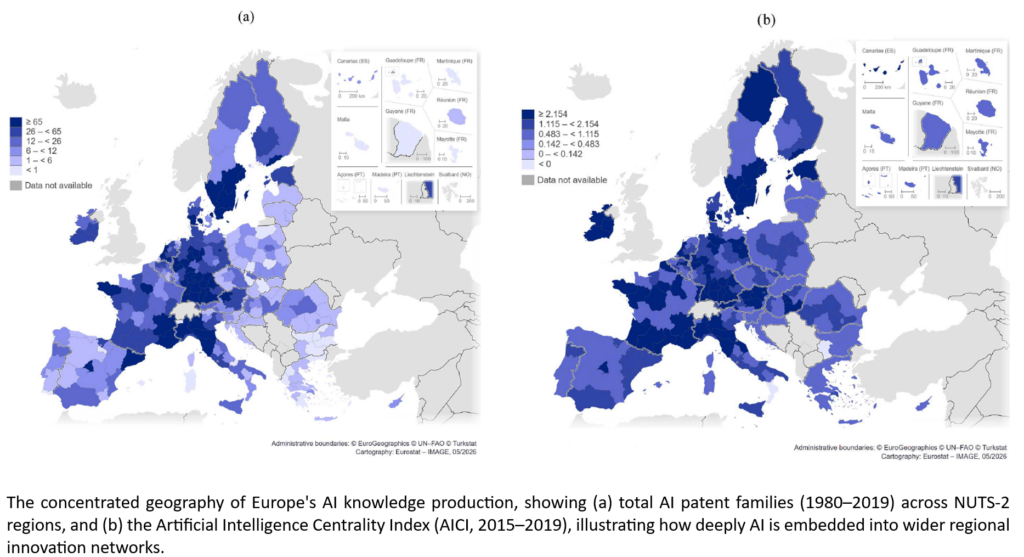
Figure 1. The concentrated geography of Europe’s AI knowledge production, showing (a) total AI patent families (1980–2019) across NUTS-2 regions, and (b) the Artificial Intelligence Centrality Index (AICI, 2015–2019), illustrating how deeply AI is embedded into wider regional innovation networks.