Anchor entrepreneurs as microfoundational agents of regional industry emergence: the genesis of Scotland’s space industry

DOI reference: 10.1080/13673882.2026.12563445
By Samantha Archard, Felicia Fai, Mariachiara Barzotto & Phil Tomlinson (e-mail)
Archard, S., Fai, F., Barzotto, M., & Tomlinson, P. R. (2026). Anchor entrepreneurs as microfoundational agents of regional industry emergence: The case of Scotland’s space industry. Regional Studies, 60(1). https://doi.org/10.1080/00343404.2026.2618707
How do new-to-the-region sectors emerge?
Most regions have a regional innovation system (RIS) — a network of organisations and institutional conditions (laws, norms, conventions) that enable the creation and diffusion of knowledge. These systems vary in strength, shape and size, with some RISs being long-established while others are still consolidating.
Established RISs often channel resources toward dominant regional sectors. This can limit a region’s capacity to pivot toward new growth trajectories. There is interest, therefore, in understanding how regions can deviate from established regional structures — such as an existing RIS — when regional transformation and/or the construction of new regional development paths is sought.
In this regard, recent work in evolutionary economic geography has begun to emphasise the role of agency (organisational and institutional actors) in creating and shaping new regional development paths. Yet much of this literature has ignored the agency of individual entrepreneurs on regional industry emergence.
In research recently published in Regional Studies, we investigate the emergence and growth of the space sector in Scotland (2002-2023) and show that individual entrepreneurs can do more than build successful firms — they can catalyse new sectors in their region by altering the organisational structure and/or institutional environment of established RISs.
Our analysis leverages concepts from several distinct literatures, that cut across economic geography, strategic management, sociology and policy research. In particular, we draw upon a microfoundation theoretical approach which seeks to explain system-level or “macro-level” changes by analysing the decisions and actions of individuals i.e., at the “micro-level”. This is then captured in Coleman’s (1986) Bathtub model of microfoundational theory, which we novelly introduce to economic geography. The Bathtub model helps to understand the links between individual decisions and actions, and system-level structures (see Figure 1).
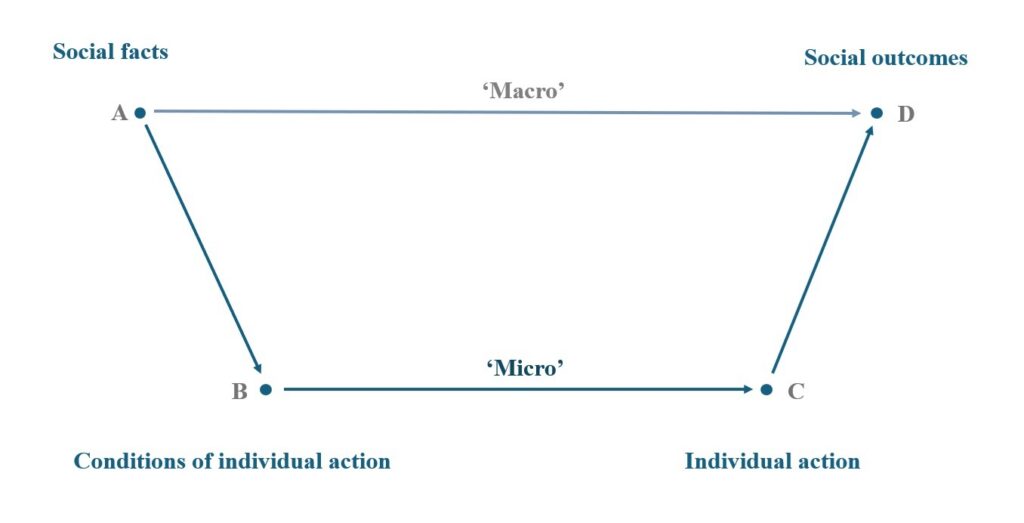
Figure 1 (a). The bathtub model of microfoundations explanation.
Source: Please see original publication. Archard, Fai, Barzotto & Tomlinson (2026).
The basic bathtub model explains how changes observed at one level – the ‘macro’/higher level, are rarely the direct effect of changes at that level (pathway A to D) but can be the cumulative result of individual actions and behaviours (micro-level) (pathway A to B to C to D).
Hence, to understand macro-level changes, one must analyse the “microfoundations” — (i) how pre-existing structures constrain or enable individuals, (ii) how those individuals behave in response, and (iii) how the individual’s actions aggregate back into macro-level alterations.
Coleman’s (1986) bathtub model breaks this observable ‘macro’ dynamic (A to D) into three components i) macro-to-micro influences (A to B), ii) individual action (B to C), and iii) a micro-to-macro influences (C to D).
In other words, the social facts of existing structures condition the actions of individual agents, who may create or take advantage of new opportunities. Some of this entrepreneurial activity may lead to new social outcomes or changes to existing industry structures. Moving from left to right (in Figure 1), represents events over time. Additionally, the bathtub can be ‘stacked’ to represent multiple layers between the macro-level and individuals, such as sectors, communities and organisations.
By conducting interviews with over 30 key stakeholders, and undertaking document analysis, we produced a chronology of the genesis of Scotland’s space industry from a single spin-out in 2002 to a thriving regional industry by 2023.
We first identified the existing industry and regional structures/conditions:
- An innovative culture with engineering heritage and pioneering inventors.
- Related regional capabilities arising from earlier space-adjacent sectors, such as aviation and defence.
- Space science strengths – research institutes that had contributed to earlier NASA space missions.
These conditions encouraged a single entrepreneur, Craig Clark, to establish Clyde Space in 2005. Clark spotted opportunities to design and manufacture small satellites in Scotland, and later proactively mobilised resources for the benefit of Scottish-based researchers and enterprises, extending collaborator networks. Scotland’s established RIS began to adapt; helping to enable the newly emerging sector.
Clark had enacted ‘change agency’ — he was no longer just an agent working under regionally determined conditions of individual action, but an agent taking individual action to catalyse changes to the existing RIS structure.
To understand Clark’s influence, we adapt the bathtub model while also drawing from the anchor entrepreneurship concept in policy research — anchor entrepreneurs are reputable actors that legitimise and accelerate industry catalysis.
Our analysis shows that when ‘Scotland’s Space Industrial Strategy’ was published in 2022, ‘agency’ was distributed among multiple actors. The capacity to influence the sector’s continuing emergence had moved from being a ‘bottom-up initiative’ driven by the anchor entrepreneur, Clark, to a ‘top-down’ systematic responsibility of multiple public- and private-sector agents to develop a strategy for the sector’s future trajectory.
Returning to the applied bathtub model, we capture the dynamics of Clark’s microfoundational influence and its powerful consequences on structures at multiple levels.
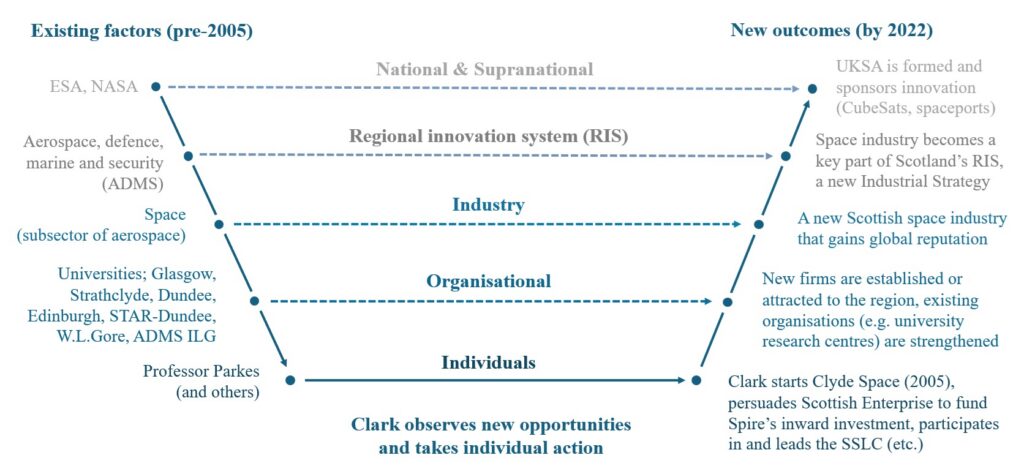
Figure 1 (b). The bathtub model of microfoundations explanation adapted for instances of anchor entrepreneurship in new regional industries.
Source: Please see original publication. Archard, Fai, Barzotto & Tomlinson (2026).
For example, Scotland might appear to have broadened its regional strengths as its space sector emerged, but the microfoundations of this change can be traced ‘downwards’. At the sector level, we observe a ‘related variety’ form of industrial evolution; Scotland was already home to space-adjacent sectors and space-related academic expertise. The microfoundations of Scotland’s space sector can be attributed to these existing capabilities attracting new firms (births and inward investments). Similarly, at the organisational level, one might observe a growing number of firms in the space sector locating in Scotland, but the microfoundations of this observed outcome are attributable to the efforts of Clark — an individual entrepreneur, who not only set up his company in Glasgow, but who also proactively persuaded other organisations (firms, local government bodies, universities) to encourage others to locate in Scotland.
Key takeaways for scholars and policymakers
By introducing microfoundational theory and the bathtub model to economic geography, our paper theoretically and empirically illustrates how an individual person (an entrepreneur) can anchor generative processes for regional industry emergence and trigger changes in established RISs in an evolutionary manner.
In doing so, our paper hopes to extend existing conceptualisations in the economic geography literature, helping to improve understanding of the ways that micro-level actions can reshape regional trajectories.
Finally, our study suggests that policymakers ought to engage much more with regional entrepreneurs since they are often best placed to identify and create new regional commercial opportunities, for example by supporting entrepreneurs through demand side incentives for research and innovation.
Reference to the original article published in Regional Studies
Archard, S., Fai, F., Barzotto, M., & Tomlinson, P. R. (2026). Anchor entrepreneurs as microfoundational agents of regional industry emergence: The case of Scotland’s space industry. Regional Studies, 60(1). https://doi.org/10.1080/00343404.2026.2618707
Read also