From Experimentation to Cumulative Capacity: Uneven Skills Governance in Regional Wine Economies

DOI reference: 10.1080/13673882.2026.12563450
By Miriana Bucalossi, Regione Toscana, Direzione Istruzione Formazione Ricerca e Lavoro, Siena, Italy (miriana.bucalossi@regione.toscana.it).
This article examines how territorial skills-governance configurations condition the capacity of specialised wine economies to transform local experimentation into institutional learning and, over time, cumulative capacity. It compares the Siena wine-producing area in Tuscany, central Italy, with the Trentino wine-producing area centred on San Michele all’Adige in northern Italy. Both cases belong to the VINO network developed within the ConnActions Italy–Germany cooperation framework in dual vocational education and training. The comparison shows that knowledge retention does not, by itself, generate cumulative capacity. This depends on whether prior learning remains accessible, can be mobilised in subsequent processes of change and is connected across institutional settings and territorial scales.
Skills governance and institutional learning
Green, digital, climatic and regulatory transitions are changing both the competences required in specialised production sectors and the conditions under which those competences are used. Expanding training provision does not, by itself, secure their effective use, because skill use depends on work organisation, productive strategies, and wider institutional arrangements (Keep and Mayhew, 2010). This is particularly relevant in wine economies, where production remains embedded in territorial knowledge and institutions while firms operate through glocal value chains (De Marchi and Grandinetti, 2016). The question is therefore not whether territories generate new knowledge, but under what governance conditions experimentation becomes learning that can be retained, institutionalised and mobilised beyond its original setting.
A relational understanding of skills ecosystems shifts attention from individual stocks of skills to the institutional relationships through which competences are formed and used (Ramsarup, McGrath and Lotz-Sisitka, 2023). These relationships connect work, education and productive organisation, but local networks cannot be treated as self-sufficient. Spours (2024) identifies the risk of “network idealism” when horizontal relations are detached from the political-economic and state conditions that enable or constrain them, while Ramsarup, McGrath and Lotz-Sisitka (2023) show why transitions in learning and work need to be understood relationally and across scales. The Viticulture Ecosystem Model (VEM), adapted to wine-producing territories from the Social Ecosystem Model (Spours, 2024; Bucalossi et al., 2026), operationalises this perspective by examining the institutional relationships through which actors coordinate across levels, policy and knowledge translate between domains, and learning stabilises over time. Governance quality concerns how these relationships operate; institutional learning and cumulative capacity are outcomes to be explained, not properties inferred from institutional form. The comparison draws on publicly available institutional, programme and sectoral documentation relating to the two territorial configurations.
Empirical setting
The empirical analysis compares the two Italian wine-producing territories included in the VINO network, developed within ConnActions, the bilateral Italy–Germany cooperation framework on dual vocational education and training (VET). The network provides a common institutional setting for examining territories facing similar sectoral transformations but characterised by different territorial configurations of education, research, production and public governance (ConnActions, 2025).
The Siena area, within the Province of Siena, forms part of a highly differentiated wine economy in central Tuscany, approximately 70 km south of Florence. Its viticultural geography includes the distinct production territories of Montalcino, Montepulciano and San Gimignano, while also intersecting the wider areas of Chianti and Chianti Classico. San Michele all’Adige lies approximately 15 km north of Trento, in the Italian Alps of northern Italy, within the viticultural area of the Campo Rotaliano and the wider Trentino wine economy. In both settings, wine production is therefore organised through territorial relations that extend across local and administrative boundaries. These relations are embedded in different institutional frameworks: the Tuscany Region constitutes the principal subnational policy level, while the Autonomous Province of Trento exercises subnational responsibilities, including in education and training. The comparison examines how these different territorial configurations organise the institutional relationships through which skills formation and knowledge mobilisation are coordinated over time.
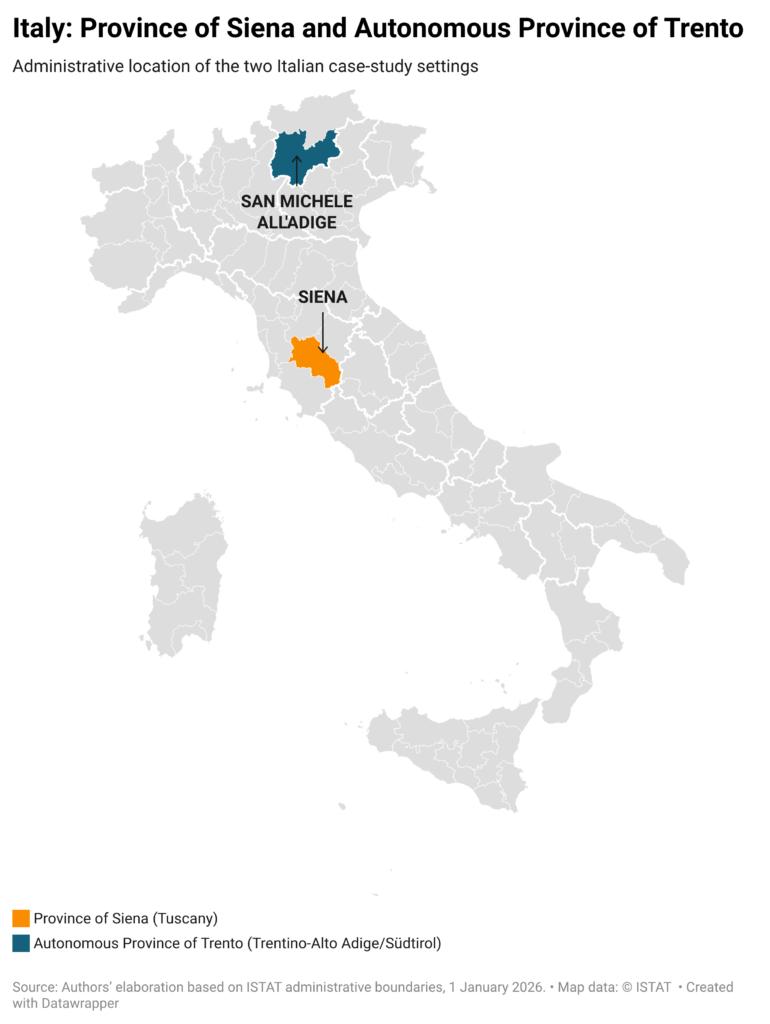
Figure 1. Administrative location of the two Italian case-study settings. Siena is located within the Province of Siena in Tuscany, while San Michele all’Adige is located within the Autonomous Province of Trento.
Comparing territorial skills-governance configurations
Skills formation, knowledge production and their relationship with productive change are organised through different institutional configurations in the two territories. In the Siena area, these functions remain distributed across distinct educational, research, productive and public-policy settings, making coordination dependent on relationships across organisational and institutional boundaries. These include the connections between specialist education at the Bettino Ricasoli Agricultural Technical Institute and firms, as well as those through which universities and research organisations bring scientific, technical and economic knowledge into the territorial system. In Trentino, a substantial part of the same functional space is concentrated around Fondazione Edmund Mach (FEM), a multifunctional institution in which specialist education is institutionally connected with research, experimentation and technical transfer, with higher education, provincial government and the productive system connected through recurrent external relationships. The contrast lies in the institutional basis of coordination: in the Siena area, it depends more extensively on relations among differentiated actors and levels, whereas in Trentino a larger share of the relevant functions is organised around FEM and connected outward through recurrent institutional relationships.
The organisation of skills formation shows how these configurations translate into different forms of institutional articulation. In the Siena area, the Bettino Ricasoli Agricultural Technical Institute delivers the nationally regulated Wine Technician (Enotecnico) qualification through a regional higher-education apprenticeship in which training is divided equally between school and company. Participating firms act as formal co-trainers, making workplace learning part of the jointly organised qualification rather than an additional placement experience. University and research contributions enter through different institutional channels, including applied research and regional knowledge infrastructures, and are not formally articulated as a continuation of this pathway. In Trentino, specialist wine education within FEM is more directly articulated with higher education and research, whereas its relationship with the productive system operates primarily through structured placements and steering arrangements. The difference lies in the form of institutional articulation: school–firm co-training operates alongside distinct university and research networks in the Siena area, while in Trentino the closer connection between specialist education, research and higher education is combined with separate interfaces with the productive system.
Beyond skills formation, these arrangements also shape how scientific and technical knowledge enters productive and regulatory practice. In the Siena area, knowledge translation depends on interfaces that connect universities and research organisations with territorial innovation processes and producer organisations. Regulatory arenas provide another route: legally defined product specifications governing protected wine denominations (disciplinari di produzione) can incorporate territorial knowledge when revised. Some of these relationships have persisted beyond the projects that produced them, while others remain linked to specific programmes or sectoral arenas. In Trentino, translation is more often embedded in standing relationships connecting research, technical transfer and the productive system, including recurrent interfaces with firms and cooperative structures. Mediation is therefore organised through different institutional arrangements: in the Siena area it is distributed across selectively connected interfaces, whereas in Trentino it is more recurrently embedded around the institutional core and within specific productive subsystems. Neither configuration, however, establishes systematic circulation of knowledge across the wider territorial system.
The temporal dimension concerns whether knowledge and practices generated through these arrangements remain institutionally available as conditions change. Organisational longevity does not in itself demonstrate that prior learning has been retained or remains available for subsequent use. In the Siena area, work-based training is reproduced across programme cycles, some project-based activities have been stabilised as continuing services, and knowledge retained within regulatory or material infrastructures has subsequently been revisited as conditions changed. In two documented sequences, previously retained knowledge is subsequently refined or recombined in response to later needs. In Trentino, retention is more closely embedded in standing infrastructures and recurrent organisational routines, including material repositories, decision-support processes and repeated certification practices. The two configurations therefore differ not in whether learning is retained, but in the institutional forms through which retention occurs and in the extent to which retained knowledge is later retrieved and connected to subsequent adaptation processes.
Institutional learning and cumulative capacity
Retention is one component of cumulative capacity, but its significance depends on whether knowledge remains accessible and can be mobilised in subsequent processes of change. Institutional learning acquires a wider territorial dimension when these processes connect knowledge across organisational settings and scales. In the Siena area, this progression is evident in several institutional settings. Knowledge and practices persist beyond individual interventions; in some cases they are subsequently retrieved and recombined in response to changing needs, while selective connections allow learning to move across settings and scales. These processes extend institutional learning beyond individual initiatives, although the connections among them remain selective rather than forming a systematic territorial process.
In Trentino, institutional learning is retained through persistent infrastructures and recurrent research-to-decision and productive routines. These processes remain primarily embedded within specific organisational and productive settings, while broader connections among retained forms of learning and subsequent recombination are not established. The comparison therefore identifies different forms and scales of institutional accumulation, but does not establish a relative difference in cumulative capacity between the two territorial configurations.
Implications for regional skills governance
For regional policy, the findings shift attention from the existence of partnerships and projects to the institutional conditions that determine what remains available after they have produced knowledge or new practices. In a configuration where learning is distributed across several initiatives and organisational settings, as in the Siena area, the central issue is whether separately retained knowledge can subsequently be retrieved and connected. Where education, research and technical-transfer functions are more institutionally concentrated, as in Trentino, the corresponding issue is whether knowledge retained within established structures can move beyond the organisational and productive settings in which it has accumulated. The comparison therefore points to continuity and institutional connection as central dimensions of regional skills governance, particularly where knowledge generated through one phase of experimentation is expected to inform subsequent processes of skills formation and sectoral adaptation.
This distinction also has implications for monitoring. Participation rates, partnership composition and organisational continuity provide limited information on whether an intervention contributes to institutional learning. A more informative approach would examine whether knowledge generated through an intervention remains institutionally accessible and whether the relationships through which it was produced allow it to inform subsequent decisions in other settings. This is also a question of vertical coordination. Territorial implementation generates experience that can contribute to subsequent programme design, regulatory adjustment and training provision when governance arrangements allow that experience to feed back into later rounds of decision-making.
From a policy perspective, the comparative evidence points to the importance of institutional arrangements that preserve learning beyond individual interventions and reconnect it to subsequent decisions. This requires channels through which experience generated in one institutional setting can be interpreted and taken up elsewhere, so that what is learned through implementation can shape subsequent responses to changing sectoral conditions. Under these conditions, local experimentation can contribute to cumulative capacity by becoming part of the institutional resources available for subsequent rounds of adaptation.
References
Bucalossi, M., Racioppo, A.R., Biancolini, A., Bastianelli, M. and Premutico, D. (2026) ‘Enhancing skill governance through apprenticeship in the wine sector: the case of Tuscany’s Wine Technician dual pathway’, in Cedefop and OECD, New fields for apprenticeship: insights for successful expansion of apprenticeships to new sectors and occupations. Publications Office of the European Union, Cedefop reference series, 130, pp. 140–153. http://data.europa.eu/doi/10.2801/2636477
ConnActions (2025) Rete VINO: Ecosistemi vitivinicoli Italia–Germania. ConnActions. https://www.connactions.eu/reti-modello/vino
De Marchi, V. and Grandinetti, R. (2016) ‘Industrial districts evolving in glocal value chains: evidence from the Italian wine industry’, Piccola Impresa / Small Business, 1, pp. 9–35. https://doi.org/10.14596/pisb.220
Keep, E. and Mayhew, K. (2010) ‘Moving beyond skills as a social and economic panacea’, Work, Employment and Society, 24(3), pp. 565–577. https://doi.org/10.1177/0950017010371663
Ramsarup, P., McGrath, S. and Lotz-Sisitka, H. (2023) ‘Reframing skills ecosystems for sustainable and just futures’, International Journal of Educational Development, 101, 102836. https://doi.org/10.1016/j.ijedudev.2023.102836
Spours, K. (2024) ‘From Learning Ecologies to a Social Ecosystem Model for Learning and Skills’, Systems, 12(9), 324. https://doi.org/10.3390/systems12090324
Author biography

Miriana Bucalossi is a policy officer at the Tuscany Region working on apprenticeship, work-based learning and European cooperation in education and training. Her research focuses on skills governance, institutional coordination, and the relationships between education, work and occupational change in regional and sectoral skills ecosystems.