Migrants, Money, and the Making of Uneven Regions: Lessons from Guangdong Province, China

DOI reference: 10.1080/13673882.2026.12563451
By Xingrong Li, University of Cambridge, UK
This article is based on Xingrong Li’s dissertation research for the MPhil in Planning, Growth and Regeneration at the University of Cambridge.
Introduction
For four decades, Guangdong (Figure 1) has been one of China’s clearest examples of two mobile factors—migrant labour and foreign capital—concentrating in the same place at the same time. Millions of internal migrants from across China and enormous volumes of foreign direct investment (FDI) have flowed into the province since the 1980s. Economic geographers have long suspected that these two flows are not simply coincidental, but mutually reinforcing: investment goes where workers are, and workers go where firms are, producing a self-sustaining cycle between labour and capital.
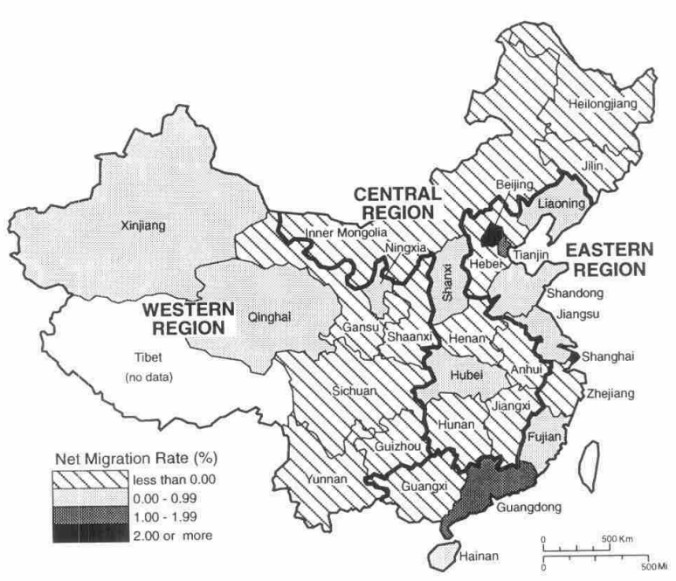
Figure 1: Net interprovincial migration rate by province, 1985 to 1990. Source: Fan (1996).
Most empirical research, however, has examined only half of this story: how FDI attracts migrants. The reverse relationship—whether migrant concentration itself attracts further investment—has received far less attention, despite being crucial to understanding this suspected migration–FDI feedback loop. A handful of empirical studies have examined this question in China, but they reach contradictory conclusions. Fan and Lu (2001) argue that migrants attract FDI using provincial data from 1985 to 1997, whereas Huang (2022) finds that larger migrant populations are associated with lower FDI inflows across Chinese cities during 2010 and 2011.
My dissertation contributes to this debate. Because the characteristics of any migration–FDI relationship may depend on geographical, institutional, and historical contexts, a short temporal focus and a nationally pooled estimate appear less appropriate. Therefore, my study adopts a regionally focused, longitudinal approach, examining cities across Guangdong Province from 2001 to 2024. It combines official statistics with two-way fixed effects (TWFE) models and cluster bootstrap inference to test whether, when, and where migrant population size is associated with subsequent FDI inflows.
Why Guangdong?
Beyond receiving large volumes of migrants and FDI simultaneously, Guangdong also provides an unusually good setting for this analysis for two reasons.
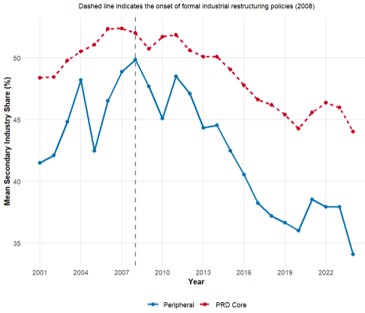
Figure 2: Evolution of secondary industry share in Guangdong, 2001 to 2024.
First, the province has undergone substantial industrial restructuring since 2008. Labour-intensive and low-value-added industries have increasingly relocated elsewhere, while Guangdong has simultaneously attracted more highly skilled labour and higher-value-added, technology-intensive investment. This changing industrial landscape provides an opportunity to examine how the migration–FDI relationship has evolved over time. Figure 2 shows changes in the share of the secondary industry in Guangdong, revealing a clear decline in both the Pearl River Delta (PRD) and peripheral regions after 2008.
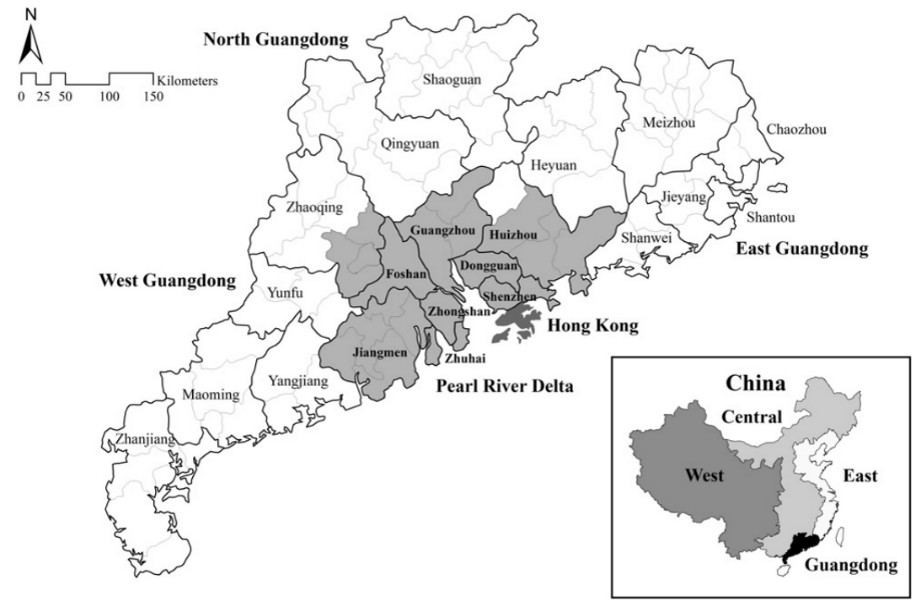
Figure 3: Guangdong and Pearl River Delta. Source: Liao & Wei (2012).
Second, substantial variation exists between Guangdong’s core region, the Pearl River Delta (Figure 3), and its periphery in both FDI inflows and migrant population size, making it well suited for analysing spatial heterogeneity. Figure 4 shows the indexed growth trajectories of migrant populations and FDI inflows across the core and periphery. While the two series appear to move together within the PRD, they exhibit much weaker synchronisation in the peripheral regions.
The analysis therefore addresses three questions: whether a robust migration–FDI association exists across Guangdong’s cities, whether this relationship changed following the province’s post-2008 industrial restructuring, and whether it differs across spatial contexts.
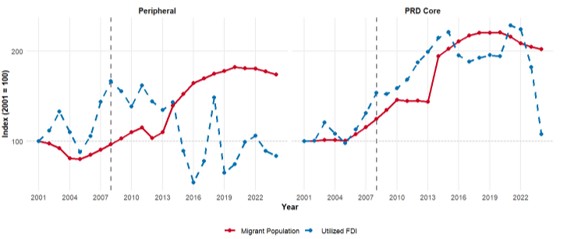
Figure 4: Indexed growth of migrant population and FDI inflows by city group, 2001 to 2024.
Three Findings
The analysis produced three main findings.
First, over the period from 2001 to 2024, no robust association between migrant population size and subsequent FDI inflows survives cluster-bootstrap inference. A small positive coefficient remains in the pre-pandemic period (2001–2019), where a one-unit increase in the inverse hyperbolic sine (IHS)-transformed migrant population is associated with a 0.089% increase in subsequent FDI inflows, suggesting that the pandemic may have disrupted the relationship. Nevertheless, given the magnitude of this estimate, there appears to be limited scope for meaningful feedback effects from migrants on FDI.
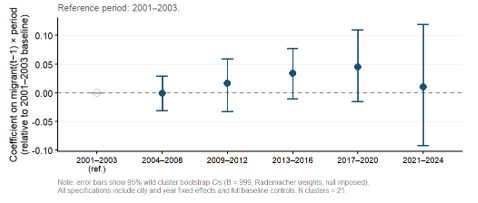
Figure 5: Migrant-FDI association by period
Second, there is weak but consistently emerging evidence that the association strengthened somewhat prior to the pandemic, following Guangdong’s post-2008 industrial restructuring. An event-study specification (Figure 5) shows the estimated relationship gradually increasing from 2008 onwards, consistent with the possibility that the micro-foundations of agglomeration, such as labour pooling and knowledge spillovers, become more important as an economy moves from low-skill manufacturing towards more knowledge-intensive activities.
Third, and most importantly, the migration–FDI association appears to be sharply conditional on existing urban hierarchies. When cities are divided into PRD core and peripheral groups, the association in the periphery is essentially zero, whereas in the PRD it becomes large and statistically significant. A one-unit increase in the IHS-transformed migrant population is associated with a 0.644% increase in subsequent FDI inflows over the full study period, providing greater scope for a potential migration–FDI feedback effect. This estimate survives cluster bootstrap inference and a battery of leave-one-out robustness checks, suggesting that the result is not driven by any single city. Therefore, whatever self-reinforcing migration–FDI dynamics exist in Guangdong, they appear to operate primarily within the province’s already agglomerated core.
What This Means
Although these findings are associational rather than causal, they nevertheless challenge the idea that the migration–FDI reinforcing dynamic is a stable and generalizable feature of regional or national development. Instead, they suggest that it may require a threshold level of pre-existing agglomeration, institutional depth, and integration into global production networks to emerge. In this way, migration and investment may reinforce existing urban hierarchies, contributing to persistent patterns of regional uneven development.
Practical Implications
For regional policymakers, three suggestive implications follow.
First, population redistribution policies aimed at spreading migrants more evenly across a province are unlikely, on their own, to stimulate investment in lagging regions if the underlying agglomeration economies and institutional conditions are absent. Such policies may carry a dual cost: weakening the virtuous cycle of labour and capital concentration in core regions while still failing to establish similar dynamics in the periphery.
Second, industrial upgrading and labour market policy should be treated as complementary rather than independent policy levers. If agglomeration economies only strengthen once an economy moves beyond low-skill manufacturing, then attracting higher-quality investment and developing local skills simultaneously may be more effective than pursuing either objective in isolation. Building both together may help regions enter a virtuous cycle of economic development.
Third, the social consequences of uneven development should be addressed separately from the spatial concentration of economic activity. Disparities in public services, income levels, and access to opportunities remain important policy concerns, regardless of whether the underlying geography of economic activity can or should be substantially altered.
References
Fan, C. C. (1996). Economic opportunities and internal migration: A case study of Guangdong Province, China. The Professional Geographer, 48(1), 28–45.
Liao, F. H., & Wei, Y. D. (2012). Dynamics, space, and regional inequality in provincial China: A case study of Guangdong Province. Applied Geography, 35(1–2), 71–83.
Fan, C. C., & Lu, J. (2001). Foreign direct investment, migration and locational factors in China, 1985–1997. Asian Geographer, 20(1–2), 79–99.
Huang, H. (2022). Urbanization diseconomies in China: roles of temporary migrant workers in foreign direct investment location. Computational Urban Science, 2, article 44.