Climate Risks and Subjective Well-being: Insights from Human Flourishing Geographic Index (USA, 2013-2023)

DOI reference: 10.1080/13673882.2026.12563444
By Stefano M. Iacus, Institute for Quantitative Social Science, Harvard University, Cambridge, MA, Haodong Qi (e-mail), Stockholm University Demography Unit, Stockholm, Sweden and Department of Global Political Studies, Malmö University, Malmö, Sweden and Devika Jain, Centre for Geographic Analysis, Harvard University, Cambridge, MA
Abstract
This article investigates the structural mechanisms through which regional climate hazards impact human flourishing across the United States. While previous research has established spatial correlations between climate risks and diminished well-being, the underlying pathways remain under-explored. Leveraging the Human Flourishing Geographic Index (HFGI)–a novel dataset derived from 2.6 billion geo-tagged tweets processed via a fine-tuned Llama 3.2 3B model–we employ Structural Equation Modeling (SEM) to disentangle these relationships. Our findings reveal that the impact of climate hazards on Subjective Well-being (SWB) is predominantly mediated by Economic Stability. Hydrological risks exert a particularly strong negative pressure on this economic foundation, far outweighing direct environmental effects. These results suggest that regional climate adaptation should shift from reactive disaster relief toward proactive socio-economic buffering (such as stabilizing insurance markets, industrial reform, and labor retraining) to provide a sense of security in an era of increasing environmental volatility.
Keywords: Climate Risks, Human Flourishing Geographic Index, Subjective Well-being, Economic Stability
Introduction
The Human Flourishing Geographic Index (HFGI) offers a novel paradigm in regional monitoring, leveraging generative AI to distill geo-tagged social media discourse into high-resolution metrics of economic and psychological well-being (Iacus et al., 2025). Preliminary investigations utilizing this index have established a clear spatial associations between cumulative climate risks and human flourishing across the United States; specifically, populations in high-exposure counties consistently express lower levels of happiness, life satisfaction, financial security, among other well-being dimensions (Iacus et al., 2026).
However, exploring correlations among these variables is only the first step. To inform effective regional climate-related policy, a more structural understanding of the mechanisms driving climatic impacts is required. It is not enough to know that climate hazards diminish well-being; we must identify how these environmental stressors penetrate the fabric of human flourishing. This article employs structural equation modeling (SEM) to untangle the pathways connecting environmental hazards—specifically thermal and hydro-related risks—to Subjective Well-being (SWB), with a particular focus on the mediating role of economic stability.
Measurements
The HFGI leverages 2.6 billion geo-located tweets from the Harvard CGA’s Geotweet Archive v2.0 (2013–2023) (Lewis and Jain, 2016). Using a fine-tuned Llama 3.2 3B model (Meta AI, 2024), we classified these tweets across 46 indicators derived from the Global Flourishing Survey (Carammia et al., 2024). Numeric values were assigned to classified labels (e.g., happiness: -1 for low, +0.5 for medium, +1 for high, and 0 for unrelated) and aggregated at the U.S. county level. Climate risk data is provided by AlphaGeo – a company leveraging proprietary algorithms to downscale Global Climate Models into six hazard indicators: Heat Stress, Wildfire, Coastal Flooding, Inland Flooding, Hurricane Wind, and Drought. We further distinguish Thermal and Hydro risks. The former includes Heat, Wildfire, and Drought risks, and the latter encompasses Coastal Flood, Inland Flood, and Wind risks. Subjective Well-being (SWB) aggregates Happiness, Inner Peace, Life Satisfaction, and Optimism. Economic Stability consists of Financial Security, Future Security, Job Satisfaction, and Mastery.
As shown in Figure 1, Climate risks generally show a negative correlation with flourishing indicators. To synthesize the multidimensional correlations identified in Figure 1, we employ a Structural Equation Model (SEM) to disentangle the direct and indirect impacts of climate hazards on human flourishing. This model moves beyond simple spatial co-occurrence to define the latent structures of risk and resilience.
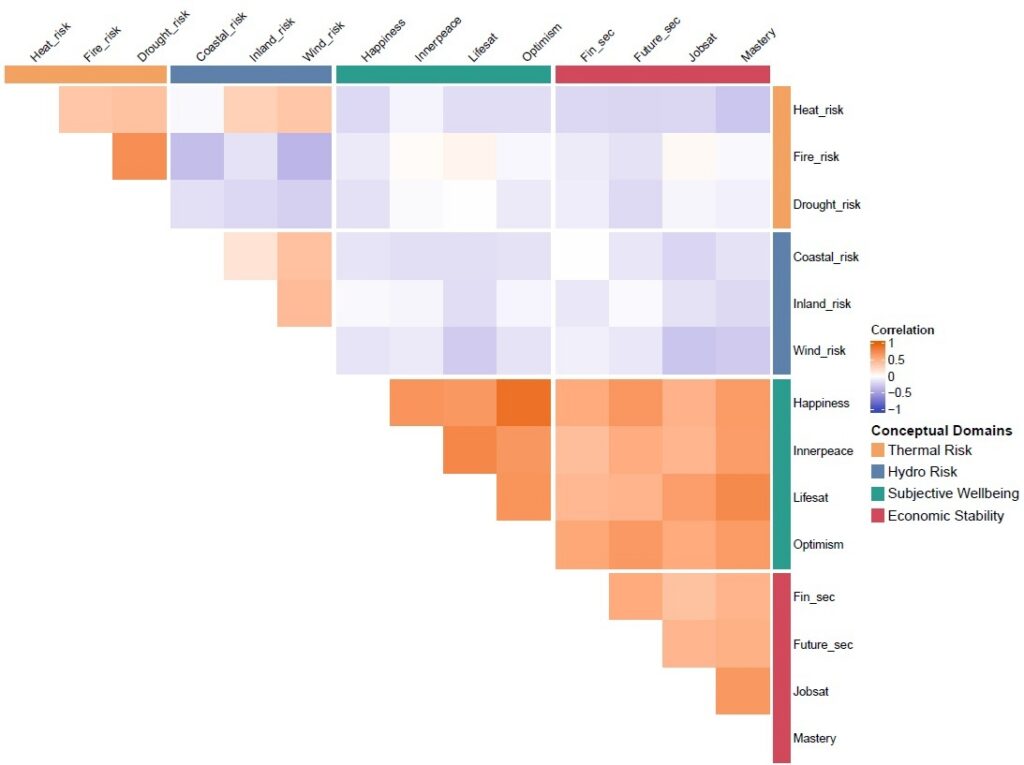
Figure 1: Correlations among the measurements of climate risks and human flourishing
Structural Equation Modeling of Human Flourishing
The Structural Equation Model is constructed around four latent variables that represent the core conceptual domains of the HFGI and regional climate data:
- Hydrological Risk: Defined by measurable exposure to coastal flood, inland flood, and hurricane-force winds.
- Thermal Risk: Shaped by the frequency and intensity of heat waves, wildfires, and prolonged
- Subjective Well-being (SWB): Latent expression of happiness, inner peace, life satisfaction, and optimism.
- Economic Stability: Captured through expressions of financial and future security, job satis-faction, and a sense of personal mastery.
Path Analysis and Results
As illustrated in Figure 2, the SEM assumes that climatic risks exert pressure on SWB through two pathways: a direct environmental impact and an indirect path mediated by economic stability. The structural estimation reveals a dominant role for economic mediation. Both Hydrological and Thermal risks significantly erode perceived Economic Stability, with path coefficients of −0.38 and −0.19, respectively. Economic Stability, in turn, is a powerful predictor of Subjective Well-being, with a large and significant positive loading of 0.88.
When accounting for the mediation through economic stability, the total effect of climate hazards on well-being is negative. The indirect negative impact via economic distress outweighs the small, positive direct coefficients (0.15 for Hydro and 0.07 for Thermal). These positive direct paths likely reflect the “amenity value” of high-risk geographies (e.g., coastal zones) that provide psychological benefits despite their objective risks.
Within the latent variables, Fire Risk (1.24) and Wind Risk (0.72) serve as the primary drivers for Thermal and Hydrological domains, respectively. On the flourishing side, Optimism and Happiness (both 0.95) are the most sensitive indicators of the latent SWB construct.
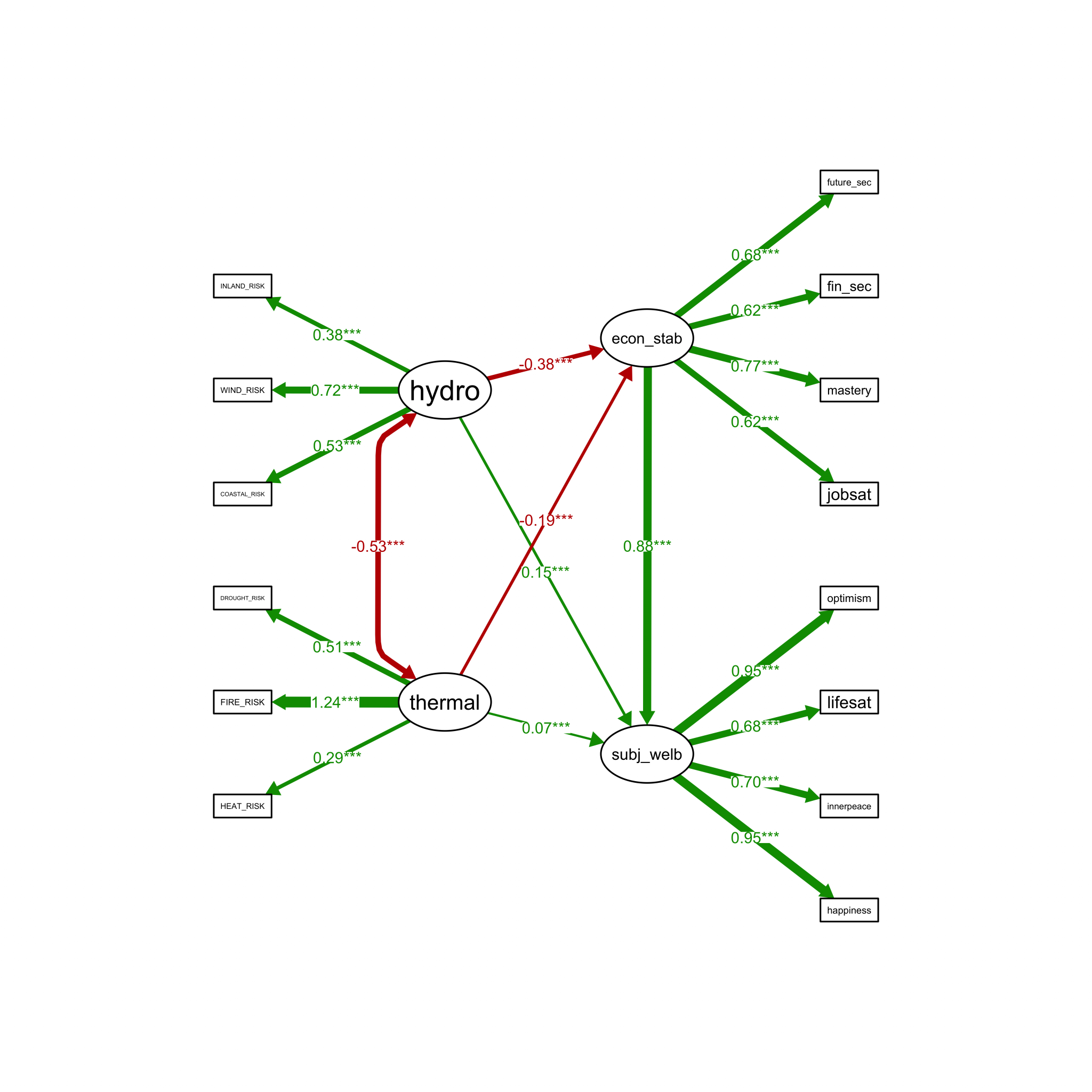
Figure 2: Structural pathways among climate risks, economic stability, and subjective well-being. Note: *p < .05, **p < .01, ***p < .001.
Geographic Distribution of Latent Flourishing
The SEM predicts four latent variable scores for every U.S. county, visualized in Figure 3. The spatial patterns reveal a “Geography of Vulnerability”. Thermal Risk is concentrated in the West and Southwest, while Hydrological Risk is clustered along the Gulf and Atlantic coasts. Areas of high latent Subjective Well-being and Economic Stability show significant overlap, particularly in the Upper Midwest and parts of the Northeast. Conversely, regions where climate risks (specifically thermal) are high and economic stability is low (such as parts of the inland West) show the lowest levels of latent well-being, highlighting where economic buffering is most urgently needed.
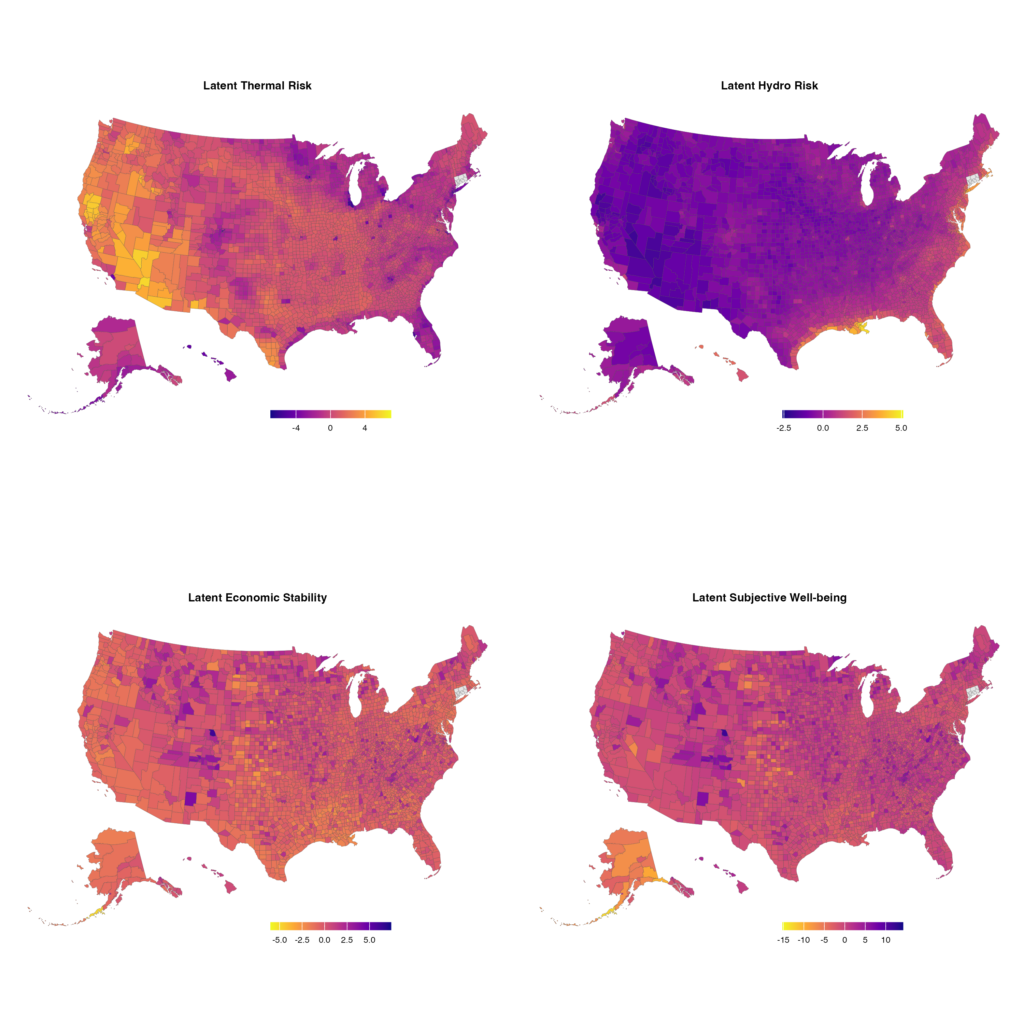
Figure 3: Latent constructs of climate risks and human flourishing.
Discussion
Through structural equation modeling, this article identified a significant mediating role of Economic Stability shaping the impact of climate risks on Subjective Well-being. This suggests that the primary “harm” of climate hazards to a region’s psyche is the erosion of financial security, job satisfaction, and the sense of mastery over one’s future.
Interestingly, once economic stability is controlled for, the direct paths from climate risks to SWB are slightly positive (0.15 for Hydro; 0.07 for Thermal). This likely reflects the “Amenity Paradox”: many high-risk areas (coastal zones or high-heat scenic regions) possess high natural amenity values that bolster well-being, even as the objective risks of living there threaten the underlying economic foundation.
Spatial mapping of the latent variables reinforces these findings. Thermal Risk is heavily concentrated in the Western U.S., particularly driven by Fire Risk (loading: 1.24). Hydro Risk dominates the Gulf and Eastern seaboards, driven largely by Wind (0.72) and Coastal Flood (0.53) factors. The maps for Economic Stability and SWB show a striking regional overlap, particularly in the Rust Belt and parts of the South, where low economic stability correlates with the lowest expressions of flourishing.
Conclusion and Policy Implications
The structural insights presented in this article reveal that regional climate adaptation must transcend traditional engineering-centric approaches, shifting toward a framework of socio-economic resilience. Our analysis demonstrates that while climate hazards possess a significant spatial footprint, their primary threat to human flourishing is structural rather than purely environmental.
The dominance of the Economic Stability to Subjective Well-being (SWB) path indicates that the psychological health of a region is fundamentally anchored in its financial and professional security. Consequently, because climate risks, particularly hydrological hazards, exert a strong negative pressure on this economic foundation, adaptation strategies must prioritize proactive economic safeguarding over reactive disaster relief.
For regional planners and policymakers, these findings suggest two strategic imperatives:
- Stabilizing Risk Transfer Markets: Policies must ensure the continuity of functioning insurance markets in high-risk zones to prevent “climate-driven financial precarity” from eroding regional well-being.
- Structural Labor and Industrial Reforms: Regions reliant on climate-vulnerable industries (e.g., agriculture in high-risk areas) require targeted workforce retraining and industry di-versification to decouple local flourishing from environmental
Ultimately, in an era of rising climatic uncertainty, regional policy should not merely aim for the survival of infrastructure, but for the sustained flourishing of the population. By treating economic stability as the primary mediator of climate impact, planners can build regions that remain resilient and optimistic, even in the face of increasing hydrological and thermal risks.
Data Availability
Data and replication scripts are available at Harvard Dataverse: https://doi.org/10.7910/DVN/BEBJML. An interactive dashboard is available at: https://ai-services.dataverse.org/r/climateRiskHFGI/.
Conflict of Interest
The authors declare no conflict of interest.
Acknowledgments
We acknowledge the support of Harvard FAS Research Computing for providing most of the computational resources, the NSF ACCESS program for providing initial computing bandwidth to start the analysis and Kempner Institute for the Study of Natural and Artificial Intelligence to allow us to use spare cycles of their GPU cluster. We thank CGA’s Xiaokang Fu for his assistance in the data processing. We also thank Parag Khanna for providing the AlphaGeo AI dataset on county-level climate risk indicators. Funding support from the Belmont Forum, the Swedish Research Council Vetenskapsrådet (grant agreement 2022–06012-3) and U.S. National Science Foundation (Award Number: 2310908) is gratefully acknowledged..
References
Carammia, M., Iacus, S. M., and Porro, G. (2024). Rethinking scale: The efficacy of fine-tuned open-source llms in large-scale reproducible social science research.
Iacus, S. M., Jain, D., Nasuto, A., Porro, G., Carammia, M., and Vezzulli, A. (2025). Human Flourishing Geographic Index (USA, 2013-2023). Harvard Dataverse: https://doi.org/10. 7910/DVN/T39JBY.
Iacus, S. M., Qi, H., and Jain, D. (2026). Spatial heterogeneity in climate risk and human flour-ishing: An exploration with generative ai. arXiv preprint arXiv:2601.20880.
Lewis, B. and Jain, D. (2016). Harvard CGA Geotweet Archive v2.0. https://doi.org/10.7910/ DVN/3NCMB6.
Meta AI (2024). Llama 3.2 – 3b model card and technical overview. https://huggingface.co/ meta-llama/Llama-3.2-3B.